Paradise has excellent branding
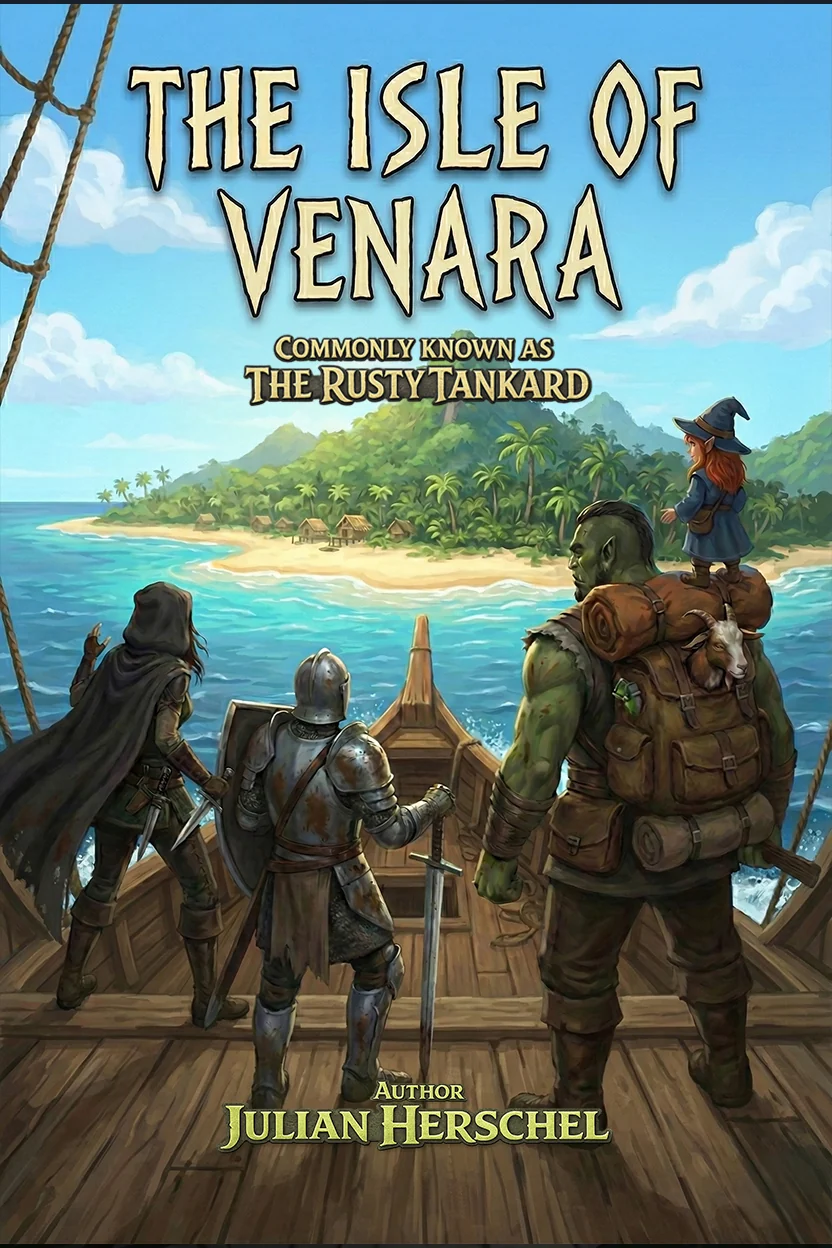
The Isle of Venara
A leaking ship, a hold full of beauty supplies, and a noblewoman who stopped writing home. Nyx follows the missing letters to Venara, where looking the part seems to matter rather too much.
New to the party? Begin with Book 1: The Succubus of the Singing Stone.
Worth staying for
More from this world
Find your next mystery and compare notes with the company. The reading guide keeps the solutions to itself.


Chapter One · Free to Read
The Soggy Biscuit
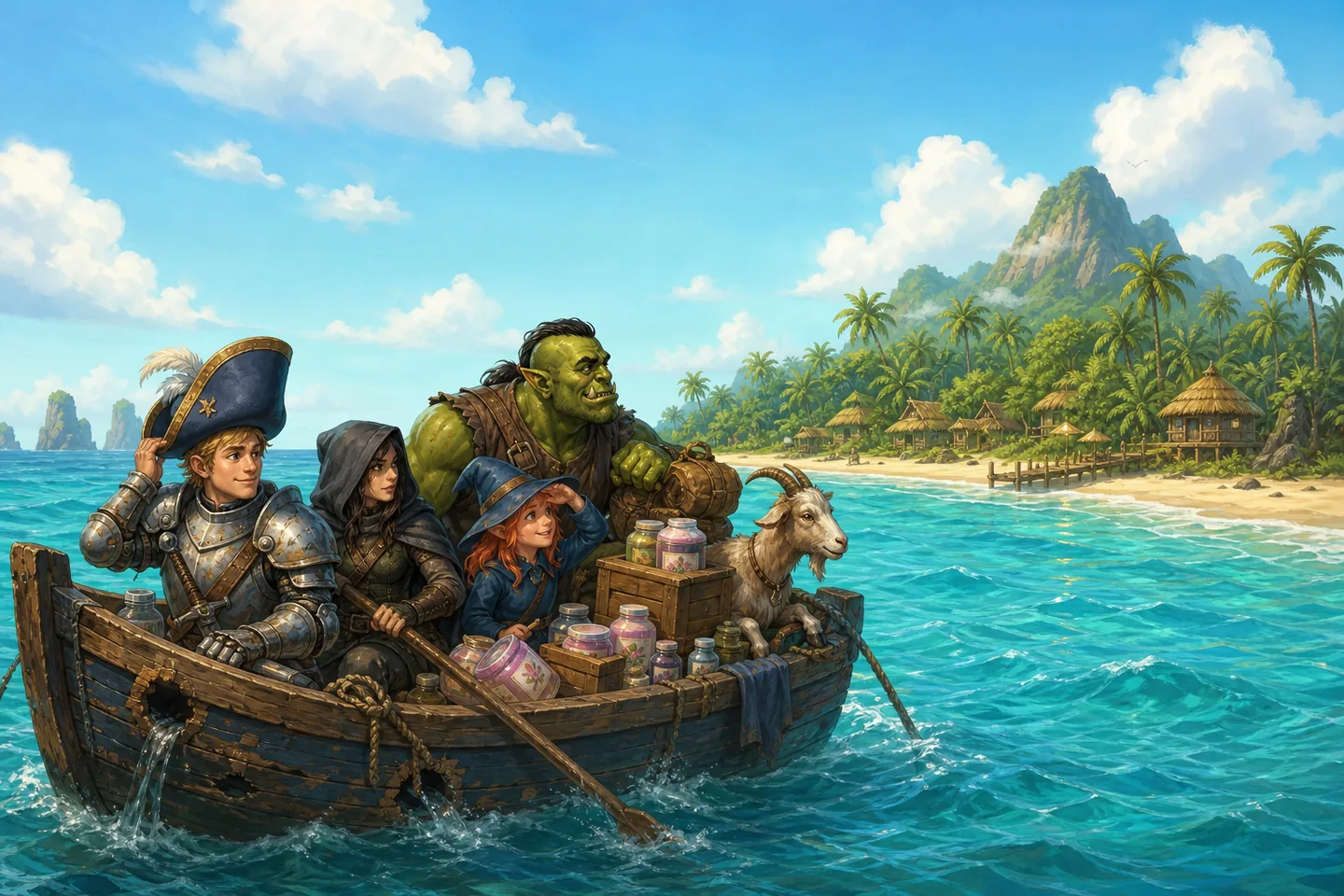
A leaking ship, questionable navigation, and an island that looks suspiciously like the brochure.
Begin the chapter ↓
Chapter One · Audio Edition
Listen by the fire
Settle in for the first chapter, then tell me if you would want the whole book in audio.
Original audio: Microsoft Edge TTS · Brian
Description
The Order of the Rusty Tankard—or whatever they are calling themselves this week—has a ship. It leaks. It came with a crew who tolerate Rolan’s navigational commands by ignoring them entirely, and a hold full of cargo bound for the most beautiful island in the known world.
Job one: deliver the cargo.
Job two: find Lady Courtney Whitmore.
She sailed to the Isle of Venara on a summer holiday and stopped writing home. Her father wants her retrieved. Not rescued. Not found. Retrieved. Like a parcel that has been misdelivered.
Venara has a reputation to maintain. White beaches. Water the precise blue that exists only in travel paintings and lies. People who look perfectly at home in both. The party has arrived with a leaking ship, beauty supplies, and questions about a missing woman. They do not quite fit the brochure.
Nyx does not trust a single thing about it.
Rolan is already workshopping the crew’s new name. Fizzle is sparking. Bash is writing. Gerald is eating the navigational charts. And somewhere on this island is the answer to why Lady Courtney’s letters stopped.
What waits on Venara
- A self-contained cozy fantasy mystery with a tropical twist
- Found-family chaos aboard a boat they probably should not own
- Beauty, vanity, and the pressure to look perfectly at home
- Nyx following the clues while everyone else follows the snacks
- Gerald delivering the island’s first honest review
Book four of Commonly Known as the Rusty Tankard. The mystery stands alone; the arguments, grudges, and goat-related votes reward reading from the beginning.
Chapter 1: The Soggy Biscuit
If the party thought traversing land with a Rolan who could not consult a map if his life depended on it — which, often, it did — was difficult, they then made the decision to throw caution to the wind and attempt to traverse the open sea with a Rolan who could not read a nautical map if you explained it to him very slowly and with lots of pictures.
“We’re not lost,” Rolan said, for the fourth time in an hour. He held the chart at arm’s length, then rotated it ninety degrees, then held it upside down, which — to his credit — was only slightly less useful than right-side up. “The compass says north. The map says north. Therefore, we are going north.”
“We need to go east,” Nyx said, from behind him.
“And we will. As soon as I establish where north is, east becomes simple. It’s just…” He gestured vaguely to the right. “…that way.”
“The sun is setting over there.”
“Yes. To the west. Which means east is—”
“Behind us. We’ve been sailing the wrong direction for two hours.”
Rolan lowered the map. He stared at the horizon. He stared at the map again, as if one of them might apologize first.
“In my defense,” he said, “the compass is very small.”
The compass was a standard compass. It was the same size as every other compass.
“So are we lost?” Nyx asked.
“No. We are merely taking a tactical surprise route. The element of surprise is—”
“We’re surprising the island?”
“We’re surprising ourselves. Keeps the crew sharp.”
Nyx looked at the helmsman. The helmsman, without turning, shook his head once. Barely. The smallest shake a head could perform and still qualify as communication. They were fine. They had always been fine. Rolan was narrating a crisis that didn’t exist, and the helmsman was letting him, because correcting him would take longer than arriving.
This was the new normal. After the Babbington job — after the locked doors and dead people — the party had found themselves in possession of the Jade Monkey. Forty thousand gold, give or take. A life-changing sum. The kind of money that bought houses, or early retirements, or — if you were particularly ambitious — a small estate somewhere green where nobody but tax collectors bothered you.
They did not buy a house. They did not retire. They did not purchase an estate.
They traded a forty-thousand-gold jade monkey for a boat.
Not a good boat. Not even a passable boat. The fence they were dealing with — a man called Hollick who operated out of a warehouse that smelled permanently of turpentine and regret — had offered them The Soggy Biscuit. Though “offered” was generous. It felt more like he was offloading it, the way someone offloads a horse that bites or a property built on a sinkhole. But that’s semantics. Nyx was against the trade. Nyx had been loudly against the trade. But finding a good fence was hard. Finding a fence who would take a forty-thousand-gold jade monkey and had the capital to trade was harder. Finding one who wouldn’t sell them out to the magistrate’s office was hardest of all. In the end for Nyx, a trade was better than a paperweight, so they got The Soggy Biscuit.
The crew came with the deal — paid by Hollick, a small bonus for the inconvenience of keeping the ship running until the new owners figured out which end was the front. (Rolan still called it “the pointy end,” which the crew tolerated with the patience of men who were being paid not to care.) They’d done this route before. They knew the heading, the currents, the stops. They could have sailed to Venara blindfolded. Which was fortunate, because Rolan had been issuing navigational commands for three days that would have put them somewhere in the middle of a continent.
“Hard to port!” Rolan would call from the bow, pointing confidently in a direction that was neither port nor relevant.
“Mhm,” the helmsman would say, and change nothing. It was a specific kind of “mhm” — the kind you give a child who is telling you about their day, where logic and make-believe are intertwined and presented as fact with equal confidence. And then the dragon was in the kitchen and he was my friend and we sailed to the moon. Mhm. The helmsman had perfected it. He could “mhm” Rolan’s most ambitious course corrections without moving the wheel a single degree, and Rolan — who was not checking the compass, because the compass was “very small” — never noticed.
And they already had a job waiting.
Two jobs, actually. The kind that came stapled to the boat like conditions on a bad loan.
The first: delivery. The Soggy Biscuit was loaded with cargo bound for the Isle of Venara. Crates of suntan lotion. Body oils. Exfoliants. Beauty creams in jars with names like “Dewdrop Radiance” and “Luminous Veil” and “Eternal Morning” — names that sounded less like skincare and more like cult recruitment pamphlets. Food, too, but the food was clearly an afterthought. The ratio of beauty products to sustenance suggested an island whose priorities were, charitably, misaligned.
Nyx had flagged this to the crew — was this a mistake? The crew had shrugged. They were professional shruggers.
The second job: find Lady Courtney Whitmore.
Daughter of Lord Whitmore — minor nobility, enough money to hire adventurers, not enough to hire good ones. She’d gone to Venara on holiday months ago and stopped writing home. Went there for a break, her father said. Never came back. He wanted her retrieved. Not “found.” Not “rescued.” Retrieved. Like a parcel that had been misdelivered. He was paying reasonably well for his standing, which meant he was either genuinely worried or merely inconvenienced, and Lord Whitmore struck Nyx as a man for whom those two states were interchangeable. He had not said “be careful with her.” He had not said “she might be scared.” He had said retrieved, and he had meant it the way you mean it about luggage.
“We find the girl, we deliver the cargo, we get paid twice,” Rolan had said, when pitching the arrangement. He’d been standing on the dock at the time, one foot on the gangplank, the other on the pier, doing what he clearly thought was a commanding captain’s pose. He looked like a man trying to do the splits and regretting it. “This is a good deal.”
“We traded a fortune for a leaking boat and two jobs that came with the boat,” Nyx had said. “This is the opposite of a good deal. This is the deal that good deals tell their children about as a warning.”
“The boat doesn’t leak.”
It leaked. Not aggressively — more of a persistent seepage, a gentle reminder from the hull that wood and water were in an ongoing negotiation and wood was losing. The crew bailed it twice a day with the casual rhythm of men who had done this long enough to stop considering it a problem.
Rolan didn’t mind. Rolan was, for the first time in his adventuring career, a captain. He had a ship. He had a crew. He had a hat — not a captain’s hat, but a hat, which he wore at an angle he believed communicated authority. It communicated that the hat was too big.
And he had been workshopping the name.
Not the ship’s name — The Soggy Biscuit was, legally, The Soggy Biscuit, and the paperwork was done. The party’s name. Because the boat demanded a rebrand. You couldn’t be The Order of the Rusty Tankard on a ship called The Soggy Biscuit. The two names occupied different genres entirely. One was adventurers-in-a-tavern. The other was… something Rolan was trying very hard to make sound heroic.
He had been muttering combinations at the crew for three days. The crew had stopped responding on day one.
“Rolan and the Soggy Biscuit Crew.”
Silence.
“The Soggy Biscuit Crew.”
The helmsman adjusted his course by one degree and said nothing.
“Ye Olde Soggy Biscuit… Crew.”
“You already said ‘Crew,’” Nyx said, without looking up from the manifest.
“The Crew… and Rolan… of the Soggy Biscuit.”
“Worse.”
“The Sea Biscuits, formerly known as the Soggy Biscuits.”
“Actively worse.”
Bash, sitting cross-legged on the foredeck with Gerald in his lap, looked up from his journal. He had been writing something. He was always writing something. The scratch of his quill had become the ambient noise of the voyage, as constant and as ignorable as the creaking of the hull.
“The name does not want to be changed,” Bash said. “Some things resist improvement.”
“Everything can be improved,” Rolan said. “That’s the entire point of branding.”
“Gerald does not agree.”
Gerald, chewing on the corner of a navigational chart he’d pulled from Rolan’s satchel, did not look up. Gerald rarely agreed with anything, but his disagreements were usually expressed through the destruction of property, which gave them a certain authority.
“What about—” Rolan tried to fall back on the old template. “The Order of the Soggy Bis—” He stopped. Closed his eyes. “Tankard. Hang on. I’ll get one.”
He did not get one.
Fizzle, perched on the railing with her legs dangling over the open water in a way that made Nyx quietly anxious, had been watching the whole exchange with the detached amusement of someone observing a bug walk into a candle flame. Her satchel sat beside her, burnt and charred like someone who sat too close to the campfire and is too prideful to move.
“You could call us The Biscuits,” she offered.
“We are not calling ourselves The Biscuits.”
“The Wet Biscuits.”
“That is objectively worse.”
“The Damp Crusaders.”
“I’m not dignifying that with a response.”
“The Soggy Knights of the—”
“Fizzle.”
“The Soaked—”
“Fizzle.”
She grinned. Her hands sparked — a tiny crackle of chaotic energy that danced between her fingers and singed the railing. A deckhand, without looking, moved two steps to the left.
“I’m just brainstorming,” she said.
“You’re arson-storming.”
“That’s not a word.”
“Neither is ‘Damp Crusaders’ and you still said it.”
The Isle of Venara appeared on the morning of the fourth day.
Rolan saw it first, because Rolan had been standing at the bow since dawn, waiting for exactly this moment. He’d positioned himself with one boot on the bowsprit and one hand shading his eyes, which was dramatic and also structurally inadvisable — the bowsprit groaned — but nobody stopped him because the view was worth the structural risk.
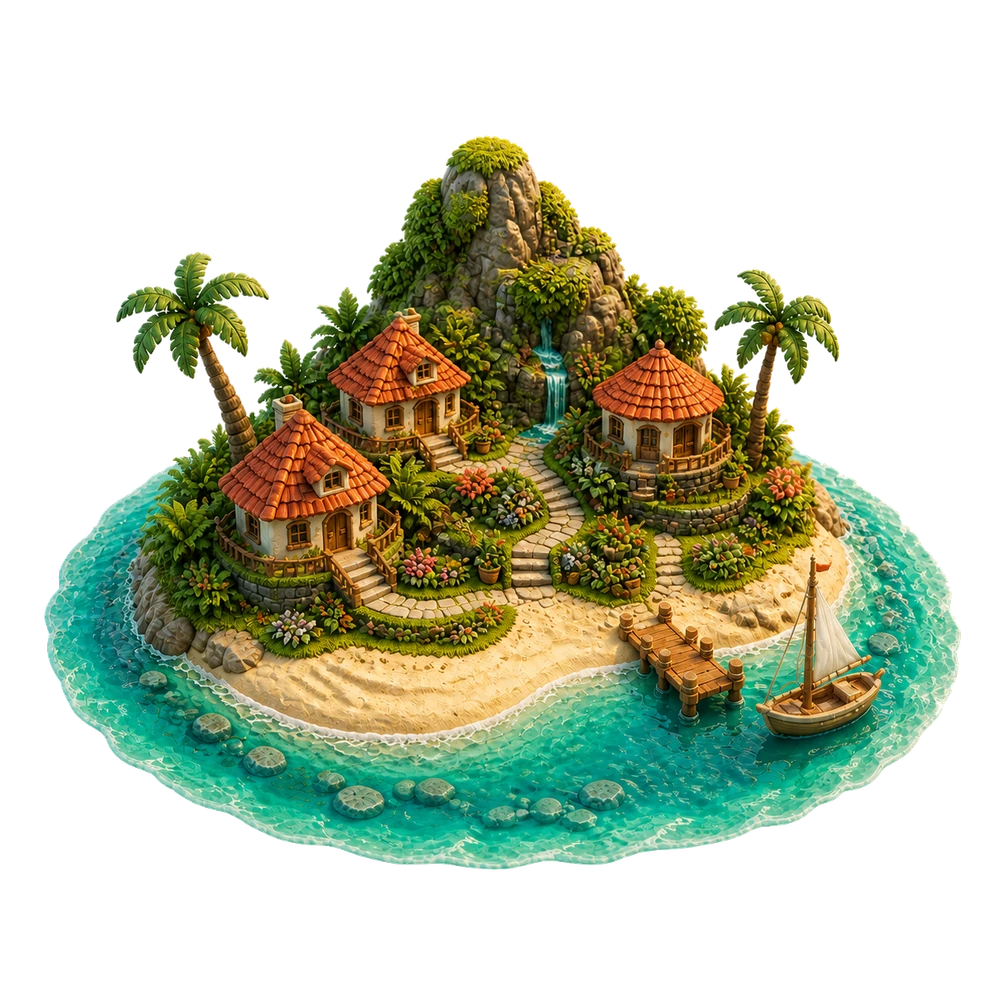
The island rose from the water like something painted. Not real-painted — idealized-painted, the kind of painting where the artist has decided that reality is fine but could use some editing. The beaches were white. The water was the precise blue that exists only in travel paintings and lies. Palm trees lined the shore in rows so even they looked planted by someone with a ruler and strong opinions.
And there was a fog around it. Not a heavy fog — more of a shimmer, a haze that clung to the island like gauze over a wound. It caught the sunlight and refracted it, turning the whole scene slightly golden, slightly soft, slightly too much. Like looking at the world through a filter that had been applied by someone who thought reality wasn’t trying hard enough.
“Beautiful,” Rolan breathed.
“Suspicious,” Nyx said.
“It is trying very hard,” Bash said, quietly, as if this made him sad.
Bash wrote something in his journal. Gerald ate the last corner of the navigational chart. The Soggy Biscuit creaked forward, listing slightly to port because it always listed slightly to port, and the Isle of Venara grew larger in the morning light.
Rolan pulled himself together. This was it. The arrival. The moment where a captain — a real captain — introduced his crew to a new land. He produced a hat he’d found in the cargo hold three days ago and placed it on top of his helmet, because Rolan believed headwear was not a single-item category. The hat was too big. The helmet was too hot. Together they achieved something that was neither authoritative nor practical but was, in Rolan’s estimation, commanding. He adjusted his armor, which he was already regretting in the growing tropical heat. He cleared his throat.
“Take the hat off,” Nyx said.
“No. Captains wear hats. If I’m not wearing one, they won’t know I’m the captain. And I am, of course… a captain.” He pointed at his hat.
Nyx had several counters to this logic, but the energy required to deliver them made her tired just thinking about it. She let it go and adopted the crew’s “mhm.”
“Right,” he said. “When we get to shore, let me handle introductions. I’ve been working on something.”
“Have you settled on a name?” Nyx asked.
“I’m… narrowing it down.”
“So no.”
“I’m narrowing it down.”
The Soggy Biscuit entered the shallows. The water turned from deep blue to turquoise to the kind of crystalline clarity that let you see the sandy bottom, which was beautiful and also revealed that the hull was in worse shape than anyone had admitted. Fish scattered beneath them. The air changed — warmer, thicker, carrying the scent of coconut and salt and something floral that Nyx couldn’t place but which made her nose itch.
They couldn’t reach the dock. The water was too shallow for the full ship — The Soggy Biscuit drew too much draft for the island’s modest pier. They’d have to anchor offshore and ferry everything in by dinghy.
The crew had been running cargo all morning — trip after trip, crates of Luminous Veil and Eternal Morning and forty pounds of facial scrub loaded into a dinghy that was less a boat and more a wooden disagreement with the concept of flotation. They handled it with the efficiency of men who had done this run before. They’d been here. They knew the route.
The last load sat on deck. Rolan straightened his hat.
“We’ll take this one in,” he said. “Deliver the cargo, handle introductions, find the girl and bring her back safely.” He said it like a general delivering the battle plan.
The crew shrugged. The crew went about their business.
Which left the matter of getting Rolan — in full plate armor, gorget to greaves, polished that morning because he wanted to make a good impression — from the deck of a ship to a dinghy bobbing six feet below on open water. The rope ladder was right there. Rolan looked at it. He looked at his armor. He did the math. The math said: heavy metal plus rope ladder plus ocean equals sinking to the bottom like a very shiny rock.
They used the cargo crane. The one meant for crates. Rolan sat in the net, legs dangling, holding his hat with one hand and his dignity with the other, and the crew winched him down to the dinghy with the mechanical indifference of men lowering freight. The crew did it without comment.
The rest of the party climbed down like normal people. Bash went carefully — the dinghy dipped four inches when his weight hit it. Gerald rode on his shoulder, ears flat. Fizzle vaulted the railing and landed in the bow. Nyx went last, silent, already scanning the shore.
They rowed to the pier. Bash unloaded the last of the cargo onto the dock while Rolan gave instructions, which mostly consisted of narrating what Bash was already doing — this being all Rolan could contribute when his armor prevented him from lifting things. They turned to face the island.
The island was stunning. Up close, it was even more absurd. The sand wasn’t just white — it was aggressively white, the kind of white that suggested someone maintained it. The palm trees swayed in the breeze. Three birds flew overhead in formation. The water lapped at the shore with the polite consistency of a metronome.
Fizzle stopped walking. Tilted her head. Squinted at the nearest palm tree.
“Is it just me,” she said, “or is that a sexy tree?”
They looked. It was a tree. But it was a tree with presence. The kind of tree you glanced at and found yourself contemplating life choices. Its bark had a warmth to it. Its fronds fell at an angle that was, somehow, flattering.
“It’s a tree,” Nyx said.
“It’s a tree with cheekbones,” Fizzle said.
“Is it just me,” Nyx said, “or does this place look—”
“Perfect,” Rolan said. “It looks perfect.”
“I was going to say ‘wrong.’”
People were approaching. Walking down the beach toward the dock. And they were—
They were beautiful.
Not attractive. Not good-looking. Not even “very good-looking.” These people were beautiful the way sunsets are beautiful, or the way sculptures are beautiful — completely, overwhelmingly, in a way that made your brain stutter and reboot. Perfect skin. Perfect teeth. Perfect posture. Every single one of them. Hair that caught the light like it had a personal arrangement with the sun. Jawlines that could cut glass. Cheekbones that had their own postcode. A line of women in swimwear stretched along the beach.
Rolan stopped walking because he needed all his brain power to focus on the task of staring.
“Oh,” he said.
“Eyes forward,” Nyx said.
“They’re very… the people are very…”
“Forward and move.”
They were smiling. All of them. Wide, brilliant, symmetrical smiles that showed exactly the right number of teeth. Nyx watched the smiles approach and felt something tighten behind her sternum.
Nobody smiles that symmetrically.
Rolan stepped forward. He planted his feet. He adjusted his hat. He drew himself up to his full height — which was considerable, honestly; Rolan cut a reasonable figure when he wasn’t tripping over things — and faced the approaching islanders with the expression of a man about to deliver the introduction he’d been rehearsing for three days on open water.
“We are The…” He paused. Glanced back at the ship. The Soggy Biscuit sat at anchor, listing gently to port, looking about as heroic as a bath toy. ”…Order of the…” Another pause. Longer. The name was supposed to go here. He’d had three days. Three days of combinations. Three days of muttering at a crew that had stopped listening. And now, standing on a white sand dock in front of the most beautiful people he’d ever seen, every combination he’d workshopped dissolved in his mouth like cheese that had turned.
“…we’re working on it,” he said.
Silence from the islanders. Still smiling. Always smiling.
He pushed forward, momentum now his only ally. “The Order of the Crowned Tankard.”
He landed on it like a man stepping off a cliff and finding ground. The Crowned Tankard would do for now.
One of the islanders — a man whose jawline could have been designed by an architect — stepped forward and said, with the easy warmth of someone who has never had a bad day:
“The note said the delivery would come from the Rusty Tankard of the Soggy Biscuit.”
Rolan’s face went through approximately five expressions in two seconds. Surprise. A brief detour through anger. And finally, the tired acceptance of a man who had been fighting a war he was losing.
”…Yes,” he said. “That’s us. The Order of the Rusty Tankard.” He left out the boat’s name.
Nyx, behind him, allowed herself the smallest smile she’d permitted in weeks.
The island was beautiful. The people were beautiful. Everything looked like a painting someone had spent years crafting.