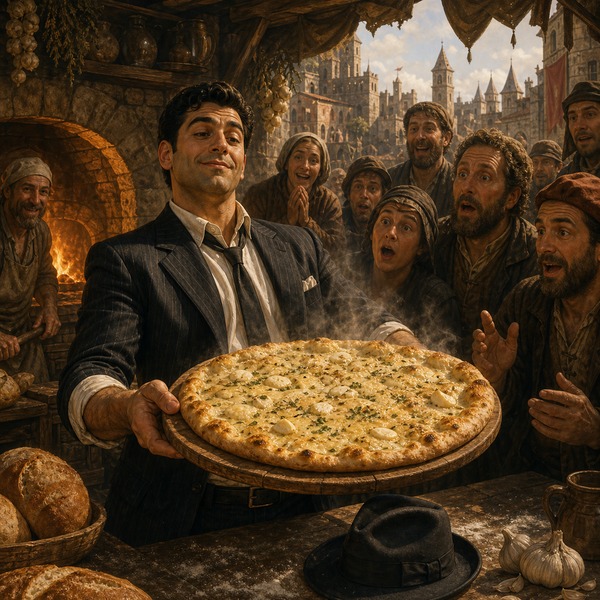
Recovered from the Red Door · Non-canonical
The Red Door's Guide to Selling Pizza in a City That Has Never Heard of Pizza
A recovered Red Door business memo on tomato shortages, guild classification, medieval delivery logistics, and the business wisdom of letting customers name the product.
A non-canonical promotional memo recovered from a back room at the Red Door: two sheets, water-stained, folded twice, and annotated by at least five different hands.
MEMORANDUM — INTERNAL. DO NOT LEAVE THIS ON A TABLE.
TO: All Personnel FROM: M. Morano RE: The Flatbread Operation, Phase One DISTRIBUTION: One copy. This copy.
[margin, pencil] — VINNY: I made two. One is in the ledger box. If the ledger box burns we lose the whole quarter.
[margin, greasy thumb] — FRANKIE: Vinny made three. He’s lying about the third one.
1. Rule One: It Is Not Pizza Yet
Nobody in this city has ever heard the word. That’s not a problem, that’s inventory. A word nobody knows is worth nothing until you make it worth something, and you don’t make it worth something by shouting it at a man carrying a goat.
So: we do not call it pizza. Not on the sign, not at the door, not to a customer, not to a guard, and especially not to anyone wearing a guild chain. We call it “the hot dish.” We call it “the flat.” When they ask what it is, you say “you want one or not,” and you hand them a wedge.
They will name it themselves. They always do. Then we agree with them, act surprised, and charge more.
[margin] — PAULIE: I’d like it on record that “the flat” is an ugly name and I’m not saying it out loud in front of people.
[margin] — MIKEY: Noted. Say it anyway.
2. The Tomato Problem
Frankie went to the market for six days looking for tomatoes. There are no tomatoes. There is nothing that is trying to be a tomato. I had him describe one to eleven separate vendors and the best result was a woman who sold him a red root that made his tongue go numb for an hour and a half.
An herb-seller offered a substitute that she swore would work, for a copper. It was faintly warm. It moved a little.
Frankie’s position, which I am recording exactly as he delivered it: we do not fake a sauce. A fake sauce is worse than no sauce. A fake sauce is an insult with cheese on it. If you build a business on a lie people can taste, the business only lasts as long as their patience, and patience around here is about two bites.
So we went white. Oil, garlic, salt, cheese, heat. That’s the whole base and it’s a better base than half of Mulberry Street was running in ‘52. Everything else goes on top: onions cooked down slow until they’re sweet, mushrooms from the fella at the north gate who does not ask what we do with them, squash in the cold months, salted fish for the dock trade, and an herb here that tastes like oregano got into a fight and won.
[margin] — FRANKIE: It is not oregano. Stop writing that it is oregano. But it is close enough that I cried a little, which stays in this room.
[margin] — SAL: (no note. There is a thumbprint here. It is not flour.)
3. Oven Access, or: Who Owns Fire
Here is what nobody tells you about a city like this. You can’t just buy an oven. You can buy the stones, you can buy the wood, you can hire the man — and then a fella in a nice hat explains that baking is a privilege, that the privilege belongs to the Bakers’ Guild, that the guild maintains the ovens, that the ovens are where bread is made, and that bread is what the guild says bread is.
In New York we’d have handled this in an afternoon. Here it took eleven days, four meetings, and Sal standing quietly in a doorway on two separate occasions.
Vinny found the seam. Read this part twice.
We are not baking bread. Bread is a loaf. Bread rises. Bread is sold by weight and taxed by the loaf. Our product is flat, sold by the wedge, served hot, and eaten with the hands off its own surface — which makes it, in Vinny’s phrasing, a serving vessel that is also the meal. It is closer to a plate than a loaf. A plate is not baking. A plate is potting.
The guild could not classify it. They spent a full session on it. They tried “pastry” — no, it’s savory and it isn’t sweetened. They tried “pie” — no, it isn’t enclosed. They tried “trencher” — closest, but a trencher is stale by definition and ours is served hot, which Frankie demonstrated by making the arbitrator eat one.
Since they couldn’t classify it, they couldn’t levy on it. They also couldn’t grant us guild oven access, which they seemed to think was the punishment. So we rented a kiln from a tile man three streets over who had capacity in the evenings and no opinions about hats.
[margin] — VINNY: The kiln man charges by the firing, not the hour, so we bake in blocks of forty. If you put in thirty-one you have burned money. Do not put in thirty-one.
[margin] — TONY: what if you put in 41
[margin] — VINNY: You can’t. There isn’t room.
[margin] — TONY: what if you stack them
[margin] — VINNY: Do not stack them.
4. Naming and Pricing
Half-copper the wedge. One and a half for the whole. The whole is not three times the wedge and don’t let anyone talk you into fixing that — the wedge is the advertisement, the whole is the sale.
Second wedge, we hold the price. Third wedge is where the money lives. A man who buys a third wedge is not hungry anymore; he is buying the feeling of the first two. That man will be back on Tuesday and he will bring his brother-in-law.
5. The Menu (Current)
- The Plain — oil, garlic, cheese. The honest one. You take it and you like it.
- The Widow’s Onion — onions cooked down two hours. Sweet enough that people ask if it’s a dessert. It is not.
- The Longshoreman — salt fish, capers, more pepper than is reasonable. Sells out by dusk at the docks.
- The Guild Buster — everything on it. Named for the eleven days. Priced accordingly.
- The Paulie — thin, even, nothing out of place, comes to the table looking better than the customer does.
- Nardone’s Disappointment — what Frankie makes when you ask for a topping he disapproves of. It is delicious and it is served with a look.
- The Tony — we let him build one. Nobody has ordered it twice. It stays on the board because he checks.
[margin] — FRANKIE: Anyone asking for sweet fruit on a savory flat gets Nardone’s Disappointment and no discussion.
[margin] — PAULIE: I want it in writing that “The Paulie” is the best-looking item and therefore should cost more.
[margin] — MIKEY: It does cost more. That’s why it’s called The Paulie.
6. Street Sampling and Repeat Business
Cut wedges, small, free, at the market corner in the last hour before the stalls close, when everybody’s tired and hasn’t eaten since morning. You are not giving away food. You are buying a habit at wholesale.
Do not explain the product. Explaining is for people who are losing. Hand it over, let them chew, then say the hours and walk away mid-sentence. Walking away mid-sentence is worth more than any sign we could hang.
7. Delivery, Which Is Now Tony’s Problem
Somebody asked if we could bring one to a house. My first answer was no. My second answer was also no. Then Vinny ran the numbers on the last hour of every firing and my third answer was fine.
Understand what delivery means inside a wall. There are no numbers on the houses. Directions here are given as “third door past the crooked well, the one with the goat.” Half the streets change names halfway down. The gates shut at dusk and the guards are — through arrangements described elsewhere and not in this memo — cooperative, but not carry-a-hot-dish-across-the-quarter-after-curfew cooperative.
So delivery requires a man who can find a stranger’s house with no address, get through four checkpoints without paperwork, be liked on sight by every guard, dog, and grandmother between here and the wall, and not eat the merchandise.
Three of those, Tony is the best we have. We are working on the fourth.
[margin] — TONY: I only ate one and it was falling apart already
[margin] — VINNY: It was not falling apart. You dropped it. There is a difference and the ledger knows.
8. Closing
We didn’t invent anything here. We took a thing people already wanted, gave it to them before they knew they wanted it, and then charged them for the privilege of agreeing with us.
You don’t sell a man what he knows. You sell him what he can’t stop talking about tomorrow.
— M.
[margin, bottom of page, different ink] — TONY: mikey what if we put it in a folded shape so people can carry it while they walk. i think i invented something
About this piece: This is a promotional, non-canonical side piece inspired by Medieval Mobsters by Julian Herschel. It’s not a chapter, it’s not required reading, and nothing in it changes anything in the book.
Curious how much of this would actually work? See Justifyin’s historical feasibility breakdown.