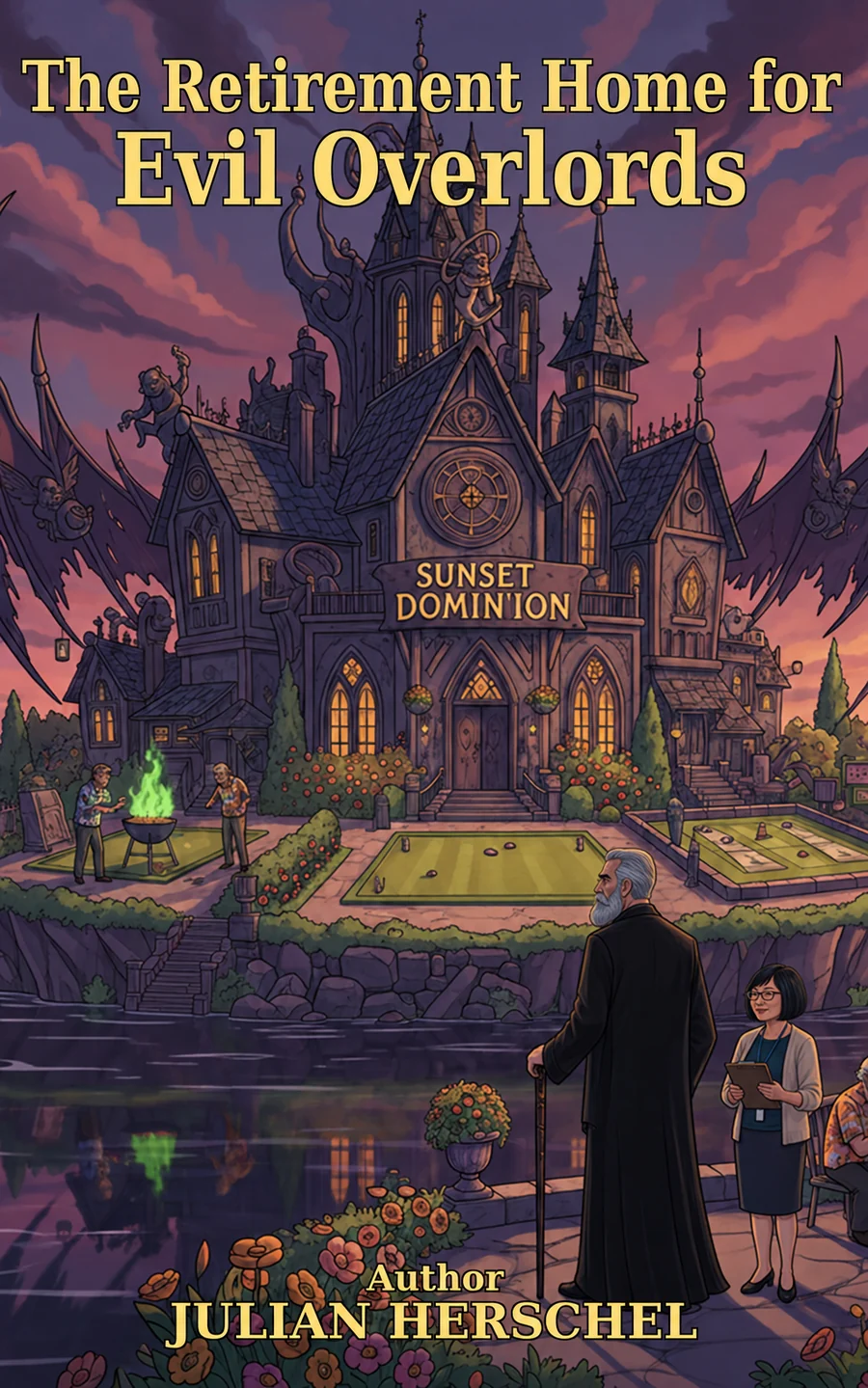
A Free Story from The Retirement Home for Evil Overlords
A Friendly Game of Empire
Five former overlords, one property board, and control of the common-room thermostat. Mordechai Grimm is absolutely not playing.
Reader-list exclusive
Unlock the story and narration
Join Julian Herschel's reader list once to read both bonus stories and listen to their complete ElevenLabs narrated editions.
Already subscribed? Enter the same email to restore access on this device.
Read below or settle in with the complete narrated edition.
Complete Audio Edition
Listen to A Friendly Game of Empire
51 minutes · Original audio: ElevenLabs · Grant Gravitas
The Complete Story
A Friendly Game of Empire
Mordechai Grimm had not agreed to play.
This distinction mattered. He had come to the common room at seven o’clock because his room was beige. He had selected the black fortress token from the small cloth bag because if he did not take it, someone else would, and there were limits.
He had counted his starting money into denominations and squared the stacks by size, largest at his left hand, because a man who cannot see his own resources at a glance is a man who will be surprised by them later. That was not playing. That was tidiness.
“Okay!” said Carlos, at the head of the table, with the bright, dangerous energy of a man who had organized things before. “Empire Estates: The Family Property Game. Five players. I’m the banker, which means I am not a player, which means please stop asking me for favorable terms, Baron.”
“I was making conversation.”
“You offered me a percentage.”
“Of the winnings,” said Volcanus, wounded. “There are none. That is what made it a gesture.”
The board lay open in the middle of the table: a loop of forty-odd spaces around a printed illustration of a city that had never existed, rendered in the cheerful, slightly crooked style of a product manufactured in enormous quantities for very little money. Properties in colored bands. A corner marked ADMINISTRATIVE REVIEW, with a small drawing of a man behind a desk. Two card decks, RESIDENT COMPLAINT and ACTIVITIES COMMITTEE, face down in their wells.
It was a map. Mordechai had spent forty years looking at maps, and his eye moved over this one the way it had once moved over the border provinces: junctions, traffic, chokepoints, the places where everything narrows and everyone must pass.
Across the room, General Zhao lowered himself into the armchair by the lamp with a cup of tea and a paperback whose cover featured a man, a horse, and an alarming shortage of shirt. He looked at the board once as Carlos smoothed the fold out of it. He looked a moment longer than the object deserved. Then he opened his book.
“Rules,” Carlos said. “Rent, improvements, mortgages, trades. You can trade anything with anyone at any price you both agree to, at any time. Bank pays out on the salary space. Bankruptcy means you’re out and your stuff goes to whoever bankrupted you. And at ten o’clock—”
“Ten o’clock,” said Linda, from the doorway, without looking up from her clipboard.
“—at ten o’clock sharp, we stop, and we total everybody’s net worth, and highest number wins. That’s a printed rule. It’s on the back page. I laminated it.”
“The game is designed to end in bankruptcies,” Mordechai said. “You have imposed a clock on a game of attrition.”
“The game is designed to take six hours,” said Linda. “Lights-down is ten. There is no version of this evening in which I let five former overlords keep a resource conflict running past midnight.”
“Then the outcome will not reflect the actual balance of power.”
“It’ll reflect the balance of power at ten o’clock.” Linda made a mark on her clipboard. “That’s the only balance of power I’m responsible for.”
“And the prize,” Carlos said, quickly, “is the common room thermostat. Winner sets it. Winner holds it until the next game night.”
There was a silence at the table of a quality Mordechai had previously encountered only in throne rooms.
“Say that again,” said Volcanus.
“The thermostat.”
Countess Seraphina Nightshade, who had not moved since sitting down and did not appear to be breathing, turned her head very slightly. “For a month.”
“Until the next game night. Which is a month.”
“I see,” she said.
Mordechai did not care about the temperature of the common room. He was, however, capable of reading a room, and this room had just acquired a war aim.
“Also,” Carlos said, producing an index card, “Rule Nine has been expanded. I’m going to read the expanded version. No magic affecting the board, the dice, the money, the players, the banker, the room, the outcome, probability, time, or the meaning of the word ‘affecting.’”
“That last clause is new,” said Doctor Voss, with interest.
“That last clause is because of you.”
“The original wording left a class of influence unnamed. I named it.”
“You named it for forty minutes.”
Ethel Darkholme arrived at that point, in a cardigan the color of dried blood, with a brooch shaped like a beetle and a cup of tea she had clearly not intended to share. She took the chair at Mordechai’s right without any of the intermediate stages of asking.
“Turn order,” she said. “How’s it being decided?”
“Highest roll goes first.”
“Then I’d like it on the record that I object to highest roll, because Volcanus warms the dice.”
“I do not warm the dice.”
“You warm everything, love. You’re a radiator with opinions.”
“Point four seven,” said Voss.
Everyone looked at her.
“The advantage of going first. Real. Small. Do not spend the evening on it.”
“That,” said Ethel, “was the most useless generous thing anyone has ever done.”
The tokens went next. Ethel took the iron fist before the bag had finished traveling and set it down in front of her with the finality of a border being redrawn. Voss took the small brass gear. Volcanus reached in and came out with a paper deed stuck to his thumb; he peeled it off with great care, examined the faint brown crescent he had left on its edge, and then, from his shirt pocket — the shirt was orange, and featured pelicans in sunglasses — produced a pair of sugar tongs from the dining hall.
“I’ll be using these,” he announced. “For the papers. Carlos, do you have the little plastic sleeves?”
“I have the little plastic sleeves.”
“Carlos, you are a great man.”
Volcanus selected the shoe, also with the tongs. There remained a tin teapot. Seraphina drew it out, turned it over once, and placed it on the starting square.
“I will take the teapot,” she said, in the tone of a head of state accepting an unfavorable border in exchange for an outcome she had already secured elsewhere.
Mordechai, watching her do it, revised two of his assumptions about the evening.
Linda tucked her clipboard under her arm. “Carlos. A word.”
“Sure!”
“Families have ended over this game.”
“Right,” said Carlos, nodding, already writing. “So — high engagement.”
Linda looked at him for a moment. Then she went to stand by the window, where she could see the whole table, and stayed there.
Mordechai rolled a nine, which put him third in order and did not matter. The fastest way to establish that the activity was beneath him was to win it so comprehensively that the question never arose again.
It was not ambition. It was hygiene.
The first three laps went quickly, in the way that the opening of any campaign goes quickly, which is to say that everyone acquired what was in front of them and nobody yet understood what they had.
Mordechai bought with discipline. He passed on four properties that other players seized with visible delight, and he did so because he had counted the spaces between the corner and the far turn and knew that the traffic on this board, like the traffic on every board and in every city he had ever administered, was not evenly distributed. He bought the Portal Shuttle. Four laps later he bought the Interdimensional Rail. He bought the first deed of Obsidian Heights — the dark blue-black band in the last quarter, the most expensive real estate the printer had seen fit to invent — for four hundred, and Carlos made a small noise.
“That’s almost a third of your cash.”
“It is precisely a third of my cash.”
“Bold.”
“It is not bold. It is the only group on this board that a single unlucky visit can decide. Everything else is arithmetic. That is where the arithmetic ends.”
Ethel bought like a woman annexing a coastline. She took three deeds in a single lap without checking her balance once, and when she landed on the middle property of the West Veranda — a pleasant green-banded stretch on the third side, mid-priced, mid-rent, and heavily trafficked — she bought it, then immediately offered Voss six hundred for the deed beside it.
“It costs two eighty,” said Voss.
“I know what it costs.”
“You are offering more than twice—”
“Yes, dear, I was there when I said it.”
“Why?”
“Because I want it.”
Voss sold. She looked faintly disturbed until her next turn, in the manner of a woman who had just been handed money in a way that violated something structural.
Seraphina bought almost nothing. She let three purchasable properties pass, declined an auction, and by the sixth lap held two deeds on the Grand Promenade — the pale gold band, the second-most expensive on the board, elegantly printed with little scrolls — and more cash than anyone else at the table.
“You are hoarding,” Ethel said.
“I am liquid,” said Seraphina.
“That’s what hoarding is.”
“No. Hoarding is what you do with the West Veranda. Liquidity is what allows me to buy the West Veranda from you later, at a price you will name yourself, at a moment I will choose.”
“You would have to ask, love. I do not sell coastlines.”
Voss, meanwhile, had done what Voss did, which was to compute a thing correctly and then explain it whether or not anyone had asked. She held two of the Foundry District’s four deeds — a drab orange-brown band immediately after Administrative Review — and had bought both deliberately.
“Everyone overvalues the expensive groups,” she said, squaring the two deeds. “They are beautiful and they are traps. This group is directly downstream of Administrative Review. Everyone released re-enters the board here, and it costs a third as much to improve. Best return per unit of capital by a factor of about one point eight.”
“That’s the ugliest bit of the board,” said Ethel.
“Yes.”
“It’s brown.”
“Yes.”
“You’re welcome to it.”
And Volcanus bought Hearthside Row.
Hearthside Row was the cheapest band on the board, a strip of three deeds in a washed-out purple immediately after the starting corner, drawn to look like three small houses with smoke coming out of them. Nobody wanted Hearthside Row. Its rents, unimproved, were six and eight dollars, which was less than the price of the dice roll that got you there. Volcanus took two of them for sixty each, held them up between his sugar tongs, admired them, and slid them into their plastic sleeves.
“Beautiful,” he said.
“They are worthless,” said Mordechai.
“They’re mine.” Volcanus set them in front of him and patted the table beside them, not quite touching. “Look at them. Little chimneys.”
Mordechai returned to his own arrangement of deeds and did not think about the chimneys again for two hours, which was, he would later have cause to reflect, precisely the intended effect, although he did not believe for one moment that it had been intended.
Somewhere in the fourth lap, Voss drew an ACTIVITIES COMMITTEE card that read Your enrichment program is a success. Collect 10 from each player, and Ethel paid her ten dollars with such violence that the little brass gear fell over. Volcanus laughed until his eyes went orange. Carlos gave three separate rulings and got two of them right. Seraphina made a remark about Ethel’s improvement strategy so precisely calibrated that Ethel had to think about it for a full six seconds before she could be offended, and when she got there she was delighted.
Then Mordechai rolled a seven, landed on the second deed of Obsidian Heights, and bought it for four hundred.
The first real trade of the night happened in the seventh lap, and Mordechai constructed it the way he had constructed everything of consequence in his life: from the far end.
Voss wanted a third Foundry deed. Mordechai had drawn it two laps earlier and had never intended to develop it. It sat in front of him, orange and worthless to him and necessary to her, and she had been looking at it every time she passed, in the way people look at a door.
“Doctor Voss,” he said. “I propose an arrangement.”
“Go on.”
“You require the Foundry deed. I will provide it. In exchange, I will take the third Obsidian Heights deed, which you acquired on the second lap and have not improved, because you cannot improve it, because you will never complete that group. In addition, I will accept two hundred in cash.”
“You want cash and the deed?”
“The deed is worthless to you and decisive to me. That is what determines its price. Not what the card says.”
Voss reached for her pencil, and Mordechai let her. He had learned long ago that people who trust arithmetic can be given all the time in the world with it.
“You complete a premium group,” she said. “I acquire a third Foundry deed. The Baron holds the fourth and has shown no attachment to it. I can complete four properties for less than you will spend improving three, and I have the traffic.”
“Yes.”
“But you gain something that cannot be taken back.”
“Yes.”
She looked at him over the top of her goggles. “Say the rest of it.”
“There is no rest of it. You have described the trade accurately. I will hold the ground you must cross. You should accept, because the alternative is that neither of us completes anything and Countess Nightshade wins by sitting still.”
“I resent,” said Seraphina, “how nearly true that is.”
Voss accepted. They exchanged the deeds. Mordechai counted the two hundred, squared it, and set it on the left of his stacks.
The table had gone slightly quiet during the last part of it, and Mordechai became aware — a beat late, which was itself unusual — of the quality of the quiet.
It was not confusion. Nobody at the table had failed to follow the trade. It was recognition. Ethel had stopped fidgeting with her brooch. Volcanus’s hands had gone still on the sugar tongs. Seraphina was watching him with an expression that was not hostile and was not admiring, and was somehow worse than either: it was the look of someone who had seen this performance before, from the other side of a table, in a room with a treaty on it.
He had made this bargain before. Many times. Twice to countries. He had used the same voice, and the same pause before the word decisive, and it had worked then too.
“Well,” said Ethel, briskly. “That was disgusting. Whose roll?”
Across the room, Zhao had looked up from his book. He held Mordechai’s eye for a moment, without judgment and without warning, and returned to the page.
By half past eight Mordechai held Obsidian Heights entire and had begun to improve it.
The improvements were small wooden blocks, painted grey, which the rules called outbuildings, and which cost two hundred each on his group and forty on Volcanus’s. He placed them with a jeweler’s precision, squaring each against the printed edge of the space, and by the end of two laps there were four on each of the three Obsidian Heights deeds and a great house on the corner property, and the last quarter of the board had become a place where a person could lose everything between the fireplace and the door.
Ethel landed on it eleven minutes later.
She paid one thousand seven hundred without a word, counting the bills out in fours, and Mordechai received them and did not gloat, because gloating is a tax on a position and he had never seen the point of paying it.
Then she bought thirteen outbuildings for the West Veranda in a single transaction and left herself with one hundred and seventy-five dollars.
“That’s overextended,” said Voss.
“That’s fortified.”
“Those are not synonyms.”
“They are where I’m from.”
Volcanus, in the meantime, had made several small trades that Mordechai had not considered worth opposing. He gave Voss the fourth Foundry deed for the Community Garden, which completed Hearthside Row. He sold her the Night Ferry for two hundred and forty. He offered Ethel eighty for a deed she did not want and paid it in full, even when she tried to reopen the price halfway through.
“You’re a terrible negotiator,” she told him.
“I know! Isn’t it restful?”
Mordechai noticed the transactions only because his own token began landing on Hearthside Row. He paid forty, then two hundred on the next circuit. Ethel paid three hundred. None of the rents seemed important beside the sums moving through Obsidian Heights, which was why he filed them as irritation rather than threat.
Around nine o’clock, the bank ran low on the small bills. Voss began removing a device from her lab coat pocket.
“I can stabilize the currency supply. It is entirely mechanical—”
“No,” said Linda.
“It has a crank.”
“Carlos, use the fifties as tens and write it on the pad.”
“On it.”
Voss put the device away. By then Seraphina held the deed that completed the West Veranda, and Ethel held the deed that completed the Grand Promenade. Neither had mentioned it for forty minutes. Mordechai respected the silence.
Grak arrived at nine-fifteen with a tray.
“Chocolate soufflé,” he announced, setting six small white ramekins along the sideboard. “They are risen. They are hot. You eat them now, in the next four minutes, or they are not soufflés anymore, they are a small sad cake with a hole in it, and I will not be responsible.”
“Thank you, Grak!” said Carlos.
“Four minutes.”
“Yep!”
Grak waited. Nobody moved. He left.
Ninety seconds later, Seraphina said: “I would like to propose an arrangement to two of you, and I would like to do it out loud, because I want Mr. Grimm to hear it.”
She laid three deeds on the table and turned them so that everyone could read them.
“The Long Gallery,” she said, “which Ethel holds, completes my group. Veranda North, which I hold, completes hers. Doctor Voss holds the fourth transport and requires nothing from either of us, which makes her the only genuinely trustworthy party at this table, and I intend to exploit that. I propose the following. Ethel and I exchange the two deeds at face value. Doctor Voss sells the Night Ferry to me — not to Mr. Grimm, at any price, ever — for six hundred, which is three times its printed value, and which she should accept, because it is three times its printed value. In return, for the remainder of the evening, none of the three of us trades with Mr. Grimm, sells to Mr. Grimm, or accepts any offer from Mr. Grimm without first informing the other two.”
“That is a cartel,” said Mordechai.
“Yes.”
He turned. “Administrator. Is this permitted?”
Linda came over, read the deeds, and looked at the laminated card. “Trades between players are allowed at any mutually agreed price. Refusing to trade with somebody is allowed. Telling each other what you’re doing is allowed.” She put the card down. “It’s legal.”
“It is a coordinated denial of assets.”
“It’s legal, Mr. Grimm.”
“I am aware that it is legal.”
“Then I’m not sure what you’re asking me.”
He was not sure either, which was an unfamiliar sensation, and he did not enjoy it.
Ethel had already picked up the Long Gallery. “Right. Terms. What’s your cut, Countess? Because you’re not doing this out of civic feeling.”
“Two hundred from each of you, payable when your groups are complete, and first refusal on anything either of you is ever forced to sell.”
“That’s steep.”
“It is the price of the arrangement existing. You are not paying for the deeds. You are paying for the fact that neither of you thought of it.”
“Fine.”
“Doctor Voss?”
Voss had been running the numbers, lips moving. “Six hundred for the Night Ferry is a good sale. Keeping Mr. Grimm to two transports also saves the three of us approximately three hundred and twenty before the cutoff.” She looked up. “He has more than he should because each of us negotiated with him separately. This corrects that.”
“That’s the spirit,” said Ethel.
“That is not the spirit. That is the arithmetic.”
“Same thing at this table, love.”
The deeds moved. Money moved. It took perhaps ninety seconds. Nobody raised their voice, nobody broke a rule, and nobody looked at Mordechai while it happened, which was the detail that landed.
He sat with his hands flat on the table and watched three people who could not beat him individually discover, in public, that they had compared notes.
It was not the loss of the transport. It was the sequence, the brokered fee, the careful public reading-out so that he would understand it had been arranged rather than improvised. He had watched this procedure from the other side of a map table before.
There was a heat behind his eyes. He was aware of it and did not permit it to reach the surface, and when he spoke his voice was steady and very formal.
“General Zhao,” he said.
Zhao lowered his book. “Yes.”
“You have watched the entire game.”
“I have.”
“I would value your assessment of the board.”
“You would value my assessment of the coalition,” said Zhao, mildly.
“I would value both.”
Zhao considered him for a moment. Then he shook his head, once, with an apology in it that did not soften the refusal at all. “No, I think not. I have watched enough of these to know that the ones who ask for help are usually the ones who are about to be interesting.” He raised the paperback. “There is a chapter here in which a duke behaves very badly on a staircase. I would rather not miss it.”
Volcanus, who had not been invited to the coalition, and about whom nobody had spoken for eleven minutes, put two more outbuildings on Hearthside Row.
Mordechai lost twelve hundred dollars before the soufflés finished collapsing and mortgaged the Portal Shuttle to cover it. Then he lost eight hundred more, removed a great house from the corner of Obsidian Heights, and sold it back to the bank at half price. While Carlos counted the refund, Mordechai did the only thing available to a man whose fortifications were being reduced by a committee.
He stopped defending, and started talking.
“Doctor Voss,” he said. “What is the improvement cost on the West Veranda?”
“One hundred and fifty.”
“And on the Foundry District?”
“One hundred.”
“And the traffic?”
“Hers is lower,” said Voss at once. “Measurably.”
“So one member of this coalition paid half again as much for less traffic and has no cash reserve.”
There was a pause.
“That’s me,” said Ethel.
“That is you.”
“He’s playing you,” Ethel said to the room. “He’s obviously playing you.”
“Yes,” said Mordechai. “That does not make it false.”
“Countess.” Voss had her pencil out again, and she was frowning at it, and Mordechai watched with a certain remote regret as she followed the numbers to where they went, because Voss could no more decline to finish a calculation than she could decline to breathe. “You structured the trade at face value. But Ethel’s deed was worth more than yours. The Long Gallery completes a group with higher rents. You paid the same and received more, and then you charged her two hundred for the privilege.”
“Yes,” said Seraphina.
“You did not mention that.”
“No.”
“You should have mentioned that.”
“Why?” said Seraphina, and for the first time all evening there was a small crack of something under the control — not guilt, but a kind of tiredness. “The terms were read out loud. Everyone at this table has run a government. I assumed we were all doing our own arithmetic.”
Ethel’s chin had come up. “I trusted you.”
“You allied with me. It is not the same word.”
“It was tonight.”
Volcanus, who had been quietly buying his eleventh outbuilding, made a small unhappy noise and set the tongs down.
The soufflés had gone flat on the sideboard. Mordechai noticed this without interest, and then, some seconds later, noticed that he had noticed, and put it away.
He had done what he had come to do. Three allies were now four hostile parties, and his position, mortgaged and reduced, was still the strongest on the board, and he had achieved this by explaining true things in the correct order to people who would not forgive each other for having heard them.
He waited to feel the thing he usually felt.
Ethel landed on the Grand Promenade at nine-thirty-one.
Seraphina had completed the group and improved it to three outbuildings apiece eleven minutes earlier. The rent was one thousand one hundred and fifty. Ethel had one hundred and seventy-five dollars, and three West Veranda deeds carrying thirteen buildings, and nothing else.
“Right,” she said.
Carlos said, “You can sell improvements back to the bank at half—”
“I know how it works, sweetheart. I’ve been playing games in this building since before you were an idea.” She reached out and took the first small wooden block off the West Veranda and set it on the table beside the board. “Seventy-five.”
“Seventy-five,” Carlos agreed, and counted it out.
She took another. “Seventy-five.”
She did them one at a time. That was the part. There was a way to do it fast — sweep the buildings off with the edge of a hand, take the money in a lump, keep talking through it — and Ethel Darkholme did not do it that way. She lifted each block off its printed square with two fingers, set it down in a row on the table, and said the number.
The row got longer. The green band got emptier. Nobody at the table said anything, and the silence had a texture to it that Mordechai recognized from the aftermath of certain sieges, when the shouting has finished and there is only the sound of things being carried away.
Her hands were entirely steady. Everybody else’s were doing something. Voss had picked up her pencil and put it down four times. Volcanus had both fists closed on the table, and between the fingers of the left one there was a thin seam of orange light, and a smell like a struck match. Carlos had stood up at some point without appearing to know it, one hand half-raised, the way a man raises a hand to stop a car that is already past him.
“Twelve,” said Ethel. “Thirteen. Nine hundred and seventy-five.” She added her remaining one hundred and seventy-five. “Eleven fifty. Take your money, Countess.”
Seraphina took it. She did not say anything, which was, Mordechai thought, the only decent thing available to her and a real cost to a woman who was very good at saying things.
Carlos sat back down. Linda, at the window, had not moved.
Two rolls later, Ethel landed on the second Obsidian Heights deed. Four outbuildings. Rent: nine hundred.
She mortgaged all three bare West Veranda deeds. Carlos counted out two hundred and sixty dollars. She still owed Mordechai six hundred and forty and had one remaining asset: the Ash Line, printed value two hundred.
The table did the arithmetic all at once, silently, and arrived at the same place, and looked at him.
Because this was the end of it. He would take the two hundred and sixty and the Ash Line and the three West Veranda deeds, and Ethel Darkholme would be out of the game at nine-thirty-eight, and he would hold the premium quarter and the middle of the board and there would be twenty minutes left in which nobody could do anything about any of it.
He looked at the little grey blocks in their row beside the board, thirteen of them, still lined up where she had set them down.
“Madame Darkholme,” he said. “I will buy the Ash Line.”
Ethel’s eyes narrowed. “It’s worth two hundred.”
“I will pay seven hundred.”
Somebody’s chair creaked.
“Seven hundred,” said Ethel.
“You will then have nine hundred and sixty dollars. You will pay me nine hundred and remain in the game with sixty dollars and three mortgaged deeds.” He squared his money stack with one finger. “A third transport doubles my rent and denies the coalition an asset it valued at six hundred. Seven hundred is a defensible market price.”
Voss had the pencil going. “The payback period is—”
“I am aware of the payback period.”
“—about nineteen minutes at observed traffic, which is nearly the entire remaining—”
“Doctor Voss.” His voice did not rise. It rarely needed to. “I am aware.”
Voss stopped. She looked at the pencil in her hand as though it had said something rude, and set it down.
Ethel did not thank him. She counted the seven hundred into her palm, counted nine hundred out of it, pushed the nine hundred across the table, and slid the Ash Line after it with one finger.
“Market positioning,” she said.
“Market positioning.”
“You’re an idiot.”
“I have been called worse by better.”
“Not tonight you haven’t,” said Ethel, and picked up the dice.
Across the room, Zhao had lowered his book to his knee. He was looking at the two hundred dollars of cardboard in front of Mordechai and at the seven hundred dollars that were no longer there, and his face had the particular stillness of a man completing a calculation of his own.
Mordechai met his eyes and offered him nothing at all.
Zhao raised the book again. He turned a page — not a page he had read, Mordechai judged; the timing was wrong by about four seconds — and said, to the room in general, “The duke has behaved appallingly. As predicted.”
Volcanus’s fists had opened on the table. The seam of orange light had gone out. He was, when Mordechai glanced over, quietly and carefully putting a fourth outbuilding onto the last of his little purple squares.
Mordechai filed what he was feeling somewhere it could not be reached.
He had not wanted her off the board. That was all. It was an entirely strategic preference regarding the distribution of assets in the final phase of play.
He was aware that this was not true. He intended to go on saying it.
At nine-forty-four Seraphina rolled a six, moved her tin teapot around the corner past the starting square, and stopped on the third little purple house.
“What,” she said, “is this.”
Volcanus checked his card, holding it in the sugar tongs. “Hearthside Row, the corner one. That’s got the great house on it.”
“That is a hotel.”
“It’s a great house! It says great house.”
“What is the rent, Baron.”
“Seven hundred and fifty.”
There was a silence of a very specific kind.
“For a purple one,” said Seraphina.
“For three purple ones,” said Voss, going very upright. Her pencil moved fast. “Two hundred for the deeds. Four hundred and eighty in outbuildings. The great house—”
“Two hundred,” said Volcanus, helpfully.
“Eight hundred and eighty dollars,” said Voss. “For a group four spaces past the starting corner, charging seven hundred and fifty per visit.”
“Wait,” said Ethel. “The Community Garden’s the third one. I thought the Community Garden was—” She stopped. “Who sold you the Community Garden?”
Everyone looked at Voss.
Voss cleared her throat.
“I traded it to him,” she said. “For the fourth Foundry deed.”
“You had a completed group riding on that deed! You could have sat on it all night. He’d never have finished!”
“I required the Foundry deed.”
“Sweetheart, the Countess offered you four hundred and fifty cash for the Community Garden. I heard her offer it. You could have blocked him all night.”
“I did not run the second calculation,” said Voss.
“Why not?”
Voss looked at the table for a moment. Then she picked up her pencil, squared her four orange deeds, and said, “Countess. Seven hundred and fifty. Pay the man.”
Zhao, in the armchair, said nothing at all, with tremendous emphasis.
Seraphina paid. She counted it out slowly, and when she had finished she sat looking at the little purple houses with their crooked printed chimneys, and Mordechai — who was doing his own arithmetic now, rapidly, and not liking the shape of it — watched her arrive at the same place he was arriving at, and saw her understand that they had spent an entire evening at war over the top quarter of the board while a man in a shirt covered in pelicans quietly annexed the neighborhood next to the front door.
“You made four trades tonight at a loss,” Seraphina said.
“Perhaps.” Volcanus put the tongs down. “Whose roll is it?”
He did not explain any further, which Mordechai found, in the moment, genuinely annoying.
“Final round,” Carlos announced at nine-fifty-five, holding his phone up like a man producing a warrant. “One more turn each and then we total. Ethel, you’re first, then Voss, then Mr. Grimm, then Volcanus, then the Countess.”
Ethel rolled a four, landed on nothing, and said something under her breath about the dice.
Voss rolled, paid Seraphina three hundred, and wrote it down.
Mordechai picked up the dice.
He had run the numbers twice while Voss was counting and he knew where he stood, which was: within reach. Obsidian Heights, one great house sold, four outbuildings apiece on the other two. Two transports mortgaged and one bought at a criminal premium. Cash, four hundred and ninety.
If he rolled a five he landed on Seraphina’s Grand Promenade and lost eleven fifty and the evening with it. If he rolled a nine he landed on Administrative Review.
He rolled a nine.
He moved the black fortress token to the corner marked ADMINISTRATIVE REVIEW and set it down beside the small drawing of the man behind the desk, and it was, he reflected, the least eventful thing that had happened to him all week and possibly the most accurate.
“Just visiting,” said Carlos.
“Yes.”
Volcanus rolled a seven and moved the shoe onto his own Community Garden.
Seraphina rolled last. She landed on her own property and did not move her face.
“Ten o’clock,” said Linda.
Carlos put both hands flat on the table. “Okay. Totals. Cash, plus printed value of all deeds you hold, plus the cost of every building on the board that’s yours. Mortgaged deeds count half. That’s the printed rule, back page, I laminated it, please do not make me get the laminated thing.”
“Get the laminated thing,” said Ethel.
Carlos got the laminated thing.
They totaled out loud, one at a time, with Voss checking each and Carlos writing.
Ethel: six hundred and fifteen.
Voss: two thousand two hundred and forty.
Seraphina: two thousand eight hundred and ninety. She had been the highest at the table nine minutes earlier. She absorbed the number without comment, which Mordechai judged cost her something.
Mordechai: three thousand and fifty-five.
Volcanus, counting on his fingers and getting it wrong twice before Voss took over: three thousand two hundred and fifteen.
Nobody said anything for a moment.
“He wins,” said Voss. “By a hundred and sixty.”
“That can’t be right,” said Ethel. “He’s got the cheap ones.”
“He has the cheap group, no debt, and eleven hundred in cash.” Voss traced the entries once, then set her pencil down. “The number is correct.”
“The buildings shouldn’t count at cost,” Ethel said. “You can only sell them back at half. Count them at half, like the mortgages. Count them at half and he’s under.”
“And so is Mr. Grimm,” said Voss.
“I’m aware of what’s under, dear, I can add.”
Everyone looked at Linda.
Linda came over, took the laminated card, read it once, and said: “Improvements are valued at purchase cost. Mortgaged deeds at half face. That’s what it says. That’s what we’re doing.”
“That’s an absurd rule.”
“It’s the printed rule. You all agreed to the printed rules at seven o’clock, including the clock, and I’m not relitigating any of them at ten past ten.” She handed the card back to Carlos. “That’s the ruling. There’s no appeal, because there’s nobody to appeal to. I’m it.”
“Then unwind the Ash Line,” said Ethel.
The table went quiet again.
“What?” said Ethel. “Look at me. I had two hundred and sixty dollars and owed him nine hundred. Without that purchase I was bankrupt, and he took everything. Reclassify it and he finishes at three thousand six hundred and seventy. He wins by four hundred and fifty-five.” Voss’s pencil remained still. It did not need to move. Ethel folded her arms. “It was not a trade. Everybody here knows it.”
“It was a purchase at an agreed price,” said Mordechai.
“It was charity.”
“It was a transport acquisition at a price the Countess established one hour earlier.” He did not look at anyone. “I do not unwind completed contracts after seeing the result.”
“You’d win.”
“I would be a man who altered the terms of a completed agreement after seeing the result. I decline.”
“You’d win, you impossible black-clad—”
“Ethel,” said Zhao, from the armchair, quite gently. “He has explained his reasoning twice.”
Ethel opened her mouth. Then she looked at Zhao for a second, and at Mordechai for rather longer, and shut it.
“Fine,” she said. “Fine. Volcanus wins. God help the thermostat.”
Volcanus stood up so fast his chair went over backwards.
“I would like to say,” said Volcanus, ten minutes later, standing at the thermostat with one hand hovering over it, “that this is the greatest achievement of my life.”
“You created an island,” said Seraphina.
“The island was mostly luck.”
“You commanded a legion of fire golems.”
“They unionized. This” — he tapped the little plastic cover — “nobody can take away from me for a month.”
“Baron. What number are you about to enter.”
“Seventy-eight.”
The sound Seraphina made was not loud. It was, Mordechai judged, worse for that.
“Seventy-eight is not a temperature. Seventy-eight is a medical event.”
“Seventy-eight is cozy.”
“I have been alive for five hundred years and I have never once been cozy and I do not intend to start in a building with this carpet.” She stood, absolutely still. “Carlos. When is the next game night.”
“Four weeks?”
“Put me down.”
“You want a rematch,” said Ethel, delighted.
“I want a correction.”
“Rematch. With revised rules. No brokerage fees, no cutoff, and improvements valued honestly—”
“The cutoff stays,” said Linda.
“The cutoff is the entire problem! The cutoff rewarded a man who spent eleven hundred dollars on a game that lasted three hours.” Ethel jabbed a finger at Mordechai. “Tell her. You said it at the start. You said it before anyone had rolled.”
Mordechai, who had been repacking the deeds into their box in denomination order, found himself in the disagreeable position of being publicly correct.
“I did say it,” he said. “The clock privileged liquidity. The result proves only what was true at ten.”
“You accepted the constitution,” said Seraphina, “at seven.”
“That is not responsive.”
“It is the whole of the response.”
He looked at her.
She looked back, with the faintest possible movement at one corner of her mouth, and then turned to inspect the thermostat again.
“Postmortem,” Voss announced, spreading Carlos’s paper out. “I want to walk through the decision tree, because there were at minimum four points where a different transaction produces a different winner, and I would like to identify—”
“No,” said everyone.
“The first is on the third lap—”
“No.”
“—when I sold the West Veranda deed to Ethel for six hundred, which I have now determined was correct, which is upsetting, because I made it emotionally.”
“You made one emotional decision tonight, dear,” said Ethel, “and it wasn’t that one.”
Voss looked at the paper.
“I know,” she said.
Volcanus, at the thermostat, appeared to be studying the little plastic cover with great attention.
Carlos, meanwhile, wrote in his notebook with the contented speed of a man filing a triumph. “Activity outcome: successful social engagement.”
“No,” said Linda.
“It was successful.”
“It was contained.” She took his pen, wrote something short, and gave it back.
“It says ‘completed as scheduled.’”
“It does.”
“Linda, there was bonding.”
Linda looked at the row of thirteen buildings. “Use mine.”
It was at this point that Grak came back for his tray.
He got three steps into the room and stopped.
Six white ramekins stood in a row on the sideboard, each containing a collapsed brown disc with a crater in the middle, cold, with a faint skin on top.
“They are sunken,” said Grak.
“Grak—” said Carlos.
“Nearly an hour. I said four minutes out loud.” He picked one up and tilted it. Nothing happened. “This was a soufflé. Now it is a small sad cake with a hole in it, exactly as I warned you, and you people—” he swept the ramekin across the board, the money, the little grey blocks “—were doing this.”
“There was a coalition,” Ethel offered.
“There is always a coalition.” Grak set the ramekin down with a click. “There has never once been a soufflé.”
He put them on the tray. Then, because he was who he was, he carried the tray to the low table by the window instead of the kitchen, and set it down, and said, “They are still chocolate. Eat them anyway. It is worse if nobody eats them,” and left.
They ate them anyway. Voss claimed, with the air of a woman making a discovery, that the texture was arguably improved. Volcanus ate two. Seraphina took one, ate three bites of it, and sat with the spoon in her hand looking out at the pocket-dimension night with an expression Mordechai chose not to interpret.
By half past ten the board was mostly packed. Carlos had the money sorted, the cards banded, and the tokens back in the cloth bag — the iron fist, the gear, the shoe, the teapot, the black fortress — and only the board itself remained open on the table, because Volcanus had gone to hold the thermostat like a man guarding a relic and nobody else had claimed the job.
On the printed square four spaces past the starting corner, one last outbuilding sat where it had been abandoned, turned about fifteen degrees off true, one corner overhanging the edge of the space.
Mordechai looked at it.
It was not his property. It was the cheapest property on the board and it belonged to a man in a pelican shirt who had beaten him by a hundred and sixty dollars, and the game was over, and the piece was going into a box in ninety seconds.
He reached across and straightened it.
Then he folded the board along its printed crease, put it in the box, and carried the box to the shelf, where he aligned its spine with the shelf edge, because the alternative was leaving it crooked, and there were limits.
There was one chair left at the low table by the window, between Zhao and Ethel, and there was one small sad cake left on the tray, and Mordechai — having no particular reason to return to a beige room at half past ten — sat down in it.
“Same time next month,” said Ethel, not looking at him.
“I will not be playing.”
“Course not.”
“I made that clear at the outset. I did not agree to play tonight. I sat down. There is a difference, and I intend to continue observing it.”
“Mm,” said Ethel, and passed him a spoon.
Zhao turned a page.
It was only when Mordechai leaned back that he felt the card taped to the chair rail behind his shoulder — a small index card, the sort Carlos used, folded once and taped on with more tape than was necessary.
He worked it loose and unfolded it.
RESERVED, it said, in a sharp, fast, unmistakably British hand.
And under that: GRIMM. HE’LL SAY NO.