
A Free Story from Medieval Mobsters
No Foreign Games
A Thornwall card game challenges the Red Door crew's nerve—and teaches Mikey that the real business is the crowd waiting to see what happens next.
Reader-list exclusive
Unlock the story and narration
Join Julian Herschel's reader list once to read both bonus stories and listen to their complete ElevenLabs narrated editions.
Already subscribed? Enter the same email to restore access on this device.
Read below or settle in with the complete narrated edition.
Complete Audio Edition
Listen to No Foreign Games
39 minutes · Original audio: ElevenLabs
Playable bonus
Play King’s Mercy
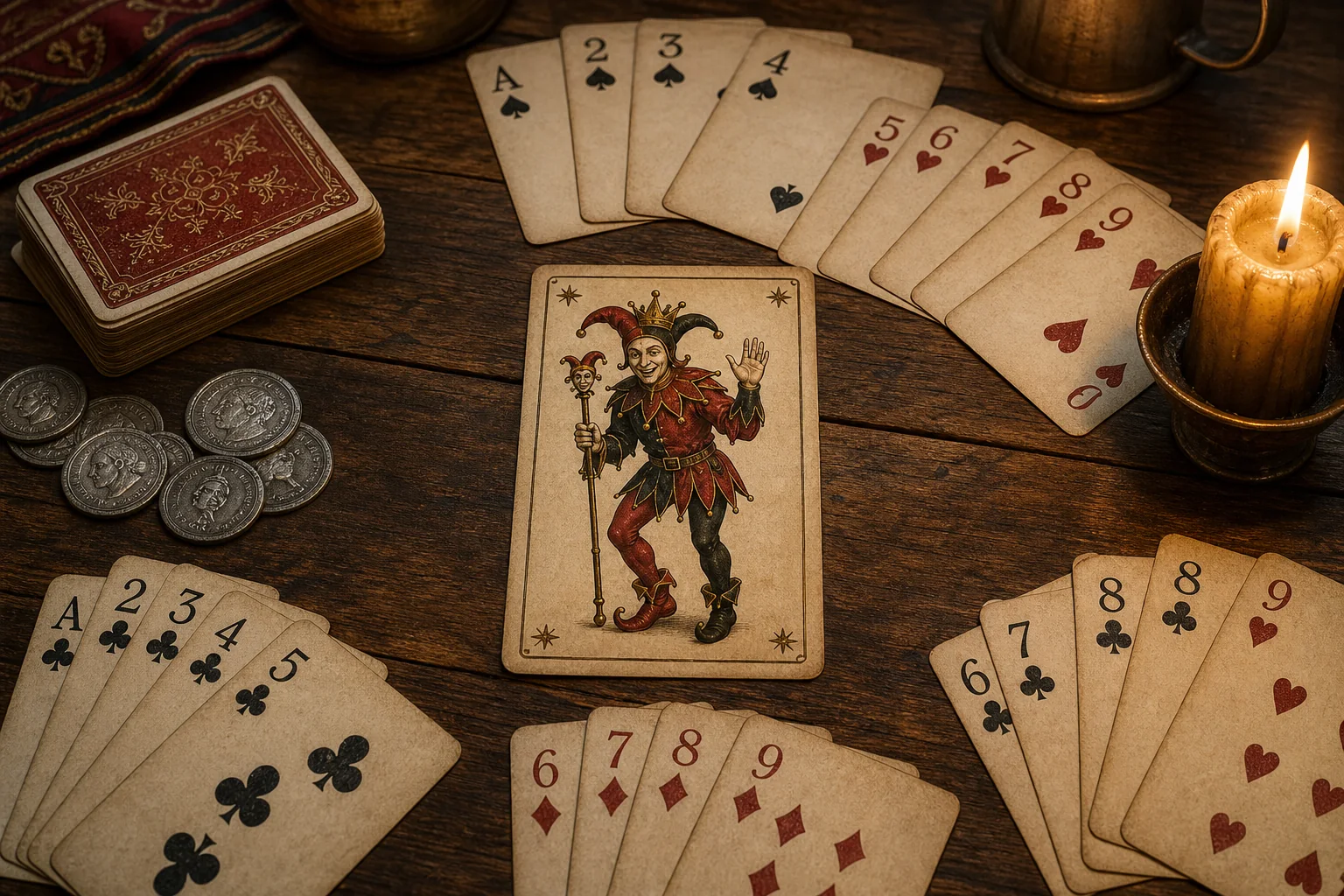
The Thornwall game from No Foreign Games works with an ordinary deck. Keep the Ace through 9 of every suit, add one Joker as the Fool, and bring three to six players.
View the complete rules
Build the 37-card deck
- Keep the Ace through 9 of every suit. Ace counts as 1 and 9 is high.
- Add one Joker. This is the Fool.
- Set aside the 10s, Jacks, Queens, Kings, and any second Joker.
No Joker? Use the King of Spades as the Fool and set aside the other three Kings. Treat it only as the Fool, never as a King.
Rank order is 9-8-7-6-5-4-3-2-Ace-Fool. Suits never rank, break ties, or make a flush.
What wins
Under normal play, hands rank from strongest to weakest:
- Three of a kind: Three ordinary cards of the same rank. Higher ranks win.
- Run: Three consecutive ordinary ranks. 7-8-9 is highest; A-2-3 is lowest. Runs do not wrap.
- Pair: Compare the pair first, then the third card.
- High card: Compare cards from highest to lowest.
The Fool is never wild. It cannot join a run, pair, or three of a kind, but it counts as the lowest third card. Fool-7-7 is a pair of sevens with the lowest possible third card.
Equal hands split the pot. An odd unit goes to the first tied player clockwise from the dealer’s left.
Set the table
- Give every player the same number of betting units. Twenty each works well.
- Choose a one-unit stake for the session.
- Pass the deal clockwise after every hand.
- A player who cannot ante sits out. A player who cannot call must fold.
Every ante, bet, and raise is exactly one unit.
Deal and bet
- Every player antes one unit.
- Deal clockwise from the dealer’s left, one card at a time, until everyone has three face-down cards. Redeal if a card is exposed.
- The first active player to the dealer’s left acts first. Check or bet one unit; facing a bet, fold, call, or raise one unit.
- Allow two raises total after the opening bet. The round closes when every active player has contributed the same amount or folded.
- Play a second betting round the same way. No cards are drawn.
If everyone but one player folds, that player takes the pot and there is no Mercy decision.
Invoke King’s Mercy
After the second betting round closes, but before an active hand is shown, the active Fool holder may say, “King’s Mercy,” and turn the Fool face up. The decision is final.
- Without Mercy, the strongest active hand wins.
- With Mercy, the weakest active hand under the normal comparison wins.
- Mercy reverses the ranking for everyone. It does not automatically make the Fool holder the winner.
- Compare hands normally, but the lower category and lower card at the first difference win. Do not start with each hand’s lowest card.
- A folded or undealt Fool cannot invoke Mercy. Ignore a false call and score the hand normally.
Under Mercy, 9-7-2 beats Fool-9-8: both are 9-high, and 7 is lower than 8.
The reckoning
After the Mercy decision, all active players turn their hands up together. Folded hands cannot win. Award the pot, then reveal the folded cards. If the Fool has not appeared, turn cards from the undealt pack until it does.
Collect all 37 cards, shuffle, pass the deal, and begin the next hand.
Tony’s mistake
Tony holds the Fool, 7, and 7. Hamon holds 9, 4, and 2.
Tony’s pair wins normally. If he invokes King’s Mercy, Hamon’s weaker high-card hand takes the pot. Holding the Fool does not mean calling Mercy is wise.
Quick reference
- Players: 3–6; three to five is more tactical, six is swingier
- Cards: Three per player
- Betting: Ante, two one-unit rounds, two raises at most per round
- Normal winner: Strongest active hand
- Mercy winner: Weakest active hand
- Hand order: Three of a kind, run, pair, high card
The Complete Story
No Foreign Games
The Red Door made money three ways, and on a good night Mikey could hear all three without getting out of his chair.
The first was Paulie, who announced drinks the way other men announced weddings.
“The Sweetheart,” Paulie said, holding the cup up over the bar. “Rose, honey, juniper, and a splash of something I’m not legally required to explain. You drink this, you go home with somebody. That’s not a promise, that’s a tendency.”
The second was Frankie, whose flatbread had turned four dockworkers into permanent residents of the long table. Nobody left the Red Door hungry. That was both policy and business model.
The third was the back room, where cards ran six nights out of seven and the house took a disclosed tenth of every finished pot, because Vinny insisted that an announced rake was a fee and a hidden rake was theft, and fees didn’t get you stabbed.
Vinny was at the end of the bar closing out a tab with a cooper who’d been arguing about it for eleven minutes.
“You had four drinks.”
“I had three.”
“You had four. The fourth one is in your hand.”
The cooper looked at his hand. The argument concluded.
Mikey watched the machine run. Wat came through with two buckets and got smaller when he saw Mikey. A waitress laughed at something a wool buyer said that could not possibly have been funny.
It was, all things considered, a beautiful Thursday.
Which is when Godwin Thatch came in and ruined it with an opinion.
Godwin arrived at the same hour every Thursday, ate white pizza with a knife like a lunatic, and drank the Union Special without ever once asking why it was called that. Tonight he came to the table, sat, folded his hands, and said, in that burbling West Country roll that Tony still maintained was Russian:
“I’ve a matter to raise, if you’ll hear me on it. As a friend of the house.”
“Every time somebody says that, it costs me money.”
“‘Tis a small thing. You keep a fine game back there. A foreign game.” Godwin took a breath. “But I’ve not once seen a proper Thornwall table under this roof. King’s Mercy, Master Morano. If you’d have Thornwall regulars, you ought to host the game Thornwall men play.”
“So my game’s not good enough.”
“Your game’s foreign.”
“Same word, different tie.”
That would have been the end of it — Mikey would have argued for ten minutes, agreed, and taken credit for the idea by Sunday — except that a man at the bar turned around on his stool.
He was maybe fifty, in a traveling coat of good grey wool. Clean nails. The face of a man who had never been asked to leave anywhere.
“The warden is being gentle with you,” he said. “Your foreign game — I watched an hour of it last evening. Men shouting numbers at one another and hoping. There’s no subtlety in it. It suits the docks. It’s a game for men who don’t like to think and don’t care to risk anything they’d miss in the morning.”
The room did not go quiet, because the room was busy, but Mikey’s part of it did.
“And you are?”
“Ambrose Fenn. Cloth factor. I buy in six towns and I play cards in all of them.” He said it pleasantly. That was the trick of it; he said the whole thing pleasantly.
Mikey looked at Al, who had appeared at his elbow the way Al always appeared.
“Al. Translate that.”
“He said your game is loud and stupid.”
“That part I got.”
Al hesitated. “He said your men don’t risk anything they’d miss. Here that means nerve. He said it before a guild warden, in your house, and smiled so he wouldn’t have to say it straight.”
“So he called us cowards.”
“He called you cowards politely.”
“See, THAT’S the part I can’t have,” Mikey said, standing up and buttoning his jacket. “Say my game’s dumb, fine. You come into my house and tell the room my guys got no nerve? Godwin. Deal your game. Right now. Deal it at that table so everybody can see.”
Godwin Thatch looked like a man who had asked for a candle and been handed a bonfire, and who was, deep down, delighted.
“I’d want it handled proper,” he said. “Cards face down till the reckoning, no man touching another man’s three, and the deck counted before and after.”
Fenn produced a narrow leather card case from inside his coat. “I have a proper deck. Cutler’s Row work.”
Godwin counted all thirty-seven cards before he allowed anyone to sit. He examined the faces, declared the deck complete, and handed it back for the cut.
“Count whatever you want. Sal, move the table.”
Sal moved the table.
They sat four: Mikey, Tony, Hamon, and Fenn. Godwin dealt and judged. Vinny stayed on his feet with the notebook, because Vinny playing meant Vinny not counting, and Vinny not counting made Vinny physically unwell.
Al gave the rules in under a minute, which Mikey appreciated, because Al had a tendency to give the history of a thing when what you wanted was the price of it.
“Thirty-seven cards. Four suits, one through nine, nine is high. And one Fool, no suit, ranking below everything. Three cards each, face down. Everyone antes, one round of betting, then a second, no more than two raises in a round. At the reckoning, every dealt card turns up, folded or not. Best hand is three alike, then a run, then a pair, then high card. The Fool can’t pair, can’t make a run, can’t count for anything.”
“So he’s garbage.”
“Except for this. If you hold the Fool, then after all the betting is closed — after, never before — you may declare King’s Mercy. Then the worse hand takes the pot.”
Mikey sat back.
“The worse hand wins.”
“If mercy is called.”
“The worse hand wins.” Mikey looked around the table for support and got none. “This is what I’m always saying about this country. You got no plumbing, and now the losing hand takes the money. You people don’t have a government, you have a suggestion.”
“‘Tis the king’s mercy,” Godwin said, wounded. “The lowest man at the table may be raised up. It is a virtue.”
“It’s a loophole with a crown on it.”
“Same word, different tie,” Godwin said, and Mikey decided he liked Godwin more than was convenient.
They anted a copper each. Godwin dealt three apiece, one at a time, face down, with the ceremony of a man laying a floor.
Fenn, Mikey noticed, did not look at his cards. He reached out first and slid the candle down the table toward the middle, turning it a quarter, then sat with his hands flat and watched the backs of the cards come out of Godwin’s fingers. Then, and only then, he picked up his three.
Hamon checked. Fenn bet two coppers. Mikey, Hamon, and Tony called. On the second round Tony pushed in two more, because Tony had bet two of whatever was in front of him since 1949 and had never once been talked out of it. Fenn studied him and folded. Mikey followed. Hamon called.
Betting closed.
Tony said, “Okay. King’s Mercy.”
Godwin’s eyebrows went up. “You’re certain, lad?”
“I got the Fool.” Tony turned it up like he was showing off a fish. “He’s the guy who asks, right? That’s what Al said. He’s got the Fool, he asks for mercy. That’s the job.”
“It is a choice, not a—”
“Nah, it’d be rude not to.”
Godwin turned the folded hands face-up and set them aside. Tony had the Fool and a pair of sevens. Hamon had a nine, a four, and a two — three cards that hated each other.
“Pair takes it, normally,” Godwin said. “But mercy’s called. The worse hand’s raised up.” He pushed the pot to Hamon.
Hamon stared at the coppers with the expression of a man who has been handed a gift he doesn’t understand and is not going to hand back.
“Tony,” Mikey said. “You had the winning hand.”
“I know.”
“You gave it away.”
“He was in a bad spot, Mikey. I was helping.”
“You were helping him. He’s not on our team. There is no team, it’s cards—”
“Then why do we all sit at the same table?”
Across the table, Ambrose Fenn laughed. It was a warm laugh. It was the warmest, most generous laugh Mikey had ever wanted to punch.
“Don’t laugh at him,” Frankie said. “That’s our table. You want to play, you play. You don’t get a show.”
“I’ll play the evening,” Fenn said, “if the young man stays.”
Tony started to get up. “I don’t think I’m any—”
“Sit down,” Mikey said. “Nobody at this table leaves because they don’t understand something. Half this city doesn’t understand anything and they’re all still here. Silver stakes, Godwin. Real ones. Vinny, write it.”
Vinny wrote it.
The next two hours were an education, and Mikey paid for all of it.
Fenn didn’t win every hand. He won maybe a third and never looked surprised. He’d fold without pain, wait four hands, then push in hard and be right.
Hamon lost the way Hamon always lost — cheerfully, steadily, and with commentary.
“I know this game,” Hamon said, putting in three silver he did not have any business putting in. “I’ve played it since I were a boy.”
“Then how come you’re down eleven?”
“Because I know it. If I didn’t know it I’d have gone home.”
Next hand, Fenn folded early. Tony pushed in his usual two coppers.
“Tony, you keep doing that and you’re gonna get pinched like Tony Earlobes.”
“Tony Earlobes didn’t get pinched. He moved to Jersey.”
“He got pinched for stealing some mook’s chain in broad daylight,” Frankie said. “Stunad.”
“I thought he got pinched for punching that prick cop,” Paulie said. “Cop had it coming, but you don’t do that unless you got dirt on him.”
“How you gonna tell me what I saw?” Frankie said. “I saw him in the cop car with my own two God-given eyes.”
“Yeah, but you don’t see so good. Maybe it was Sonny the Rat.”
“You think I can’t tell Tony Earlobes from Sonny the Rat? Sonny’s forty pounds heavier and bald like Tony’s uncle.”
“Angelo with the comb-over?” Vinny said.
“Yeah, that prick. No offense, Tone, but your uncle might be the stupidest guy I ever met.”
“I agree,” Tony said. “He’s still my uncle. That’s not nice.”
“What’s Angelo got to do with the arrest?” Vinny asked.
“Nothing. We’re talking about Tony Earlobes.”
“I thought we were talking about my bet.”
“What the hell were we talking about?” Frankie said.
“Tony Earlobes got pinched,” Mikey said.
“Twice,” Sal said from the wall. “Chain first. Cop second. Jersey after.”
As they argued, Fenn squared his folded three, thumb riding the same lower edge before he passed them to Godwin. Paulie lingered with his tray and watched.
“Can one of you play your hand?” Fenn said.
“We’re talking,” Mikey said.
On the next deal, Hamon drank three times before the first bet reached him.
“What’re you gonna do, fold?” Mikey said. “I know you’re not betting that pair of twos.”
“You don’t know what I hold.”
“I got your number. Good cards, you don’t drink. Bad cards, you pour it down like the roof’s on fire. Fold. Save yourself the silver.”
Hamon looked at his cup, looked at Mikey, and folded.
“He’s right,” Frankie said. “Now do Mikey.”
“Mikey fixes his tie when he’s bluffing,” Vinny said, without looking up from the notebook. “Four times tonight. He’s doing it now.”
Mikey’s hand was at his collar.
“That’s not a tell. That’s standards.”
“Raise,” Fenn said pleasantly, pushing four silver forward.
Mikey folded. At the reckoning Godwin turned every hand. Hamon had a two, a two, and a six. Mikey’s eight-high looked exactly as bad as it was.
“Told you,” Mikey said, three silver lighter.
“You’re playing this like it’s poker,” Vinny said quietly. “It ain’t. The Fool makes the winner the loser after the money’s in.”
“So how do you play it?”
“You’d have to know where the Fool is.”
“Nobody knows where the Fool is.”
“That’s what I’m saying. Nobody does.” Vinny frowned at his notebook, and Mikey filed the frown.
Word escaped the Red Door. By the second hour forty extra bodies filled the main room, and the men who couldn’t see were paying the ones who could for descriptions.
Paulie ran it like a man conducting weather.
“Cups up, gentlemen, nobody watches a card game dry — this is a Bronx Sunset, honey and fire, three coppers, and yes you can drink it standing.” He never stopped moving.
Frankie sold flatbread standing on a bench. Frankie also, somewhere around the ninth hand, opened a book.
“It’s not gambling,” Frankie explained, to Al, who had not asked. “Gambling is a game of chance. This is a game of opinion. These men have opinions. I’m collecting them, and I’m holding a small fee for the labor of the collection.”
“You are taking bets on which man wins the next hand.”
“I’m taking opinions, Al.”
“And on whether mercy will be called.”
“That’s a separate book. Completely different instrument. You can’t mix them, that’d be irresponsible.”
Soon Frankie had two sets of slips and a charcoal stub.
And Vinny, moving between the table and the bar, said in Mikey’s ear: “Room receipts are up. Way up. Paulie’s turned over eighteen cups in the last half hour and Frankie’s out of the second batch.”
“We’re getting cleaned out at the table.”
“Right. But the room’s never done a night like this. I’m just noting it.”
“Note it later.”
The crowd enjoyed watching a polished merchant take money off the foreigners in their own place. Mikey stayed in. You never left while somebody else was deciding what the room meant.
“Raise it,” Fenn said, easily, pushing four silver forward. “Unless the docks would rather not.”
The suspicion arrived in pieces, the way it does, and the first piece was Vinny.
He crouched next to Mikey’s chair between hands with the notebook open and his voice down at the level he used for things he didn’t want a room to hear.
“Nineteen hands where the Fool got dealt to somebody other than him. He’s been in for the first round on fifteen of those, which is normal, he’s in on almost everything early. He’s put money in the second round twice.”
“So he’s careful.”
“Mikey, he doesn’t get careful. He’s not careful with Hamon, he’s not careful with you, he raises you off a hand every twenty minutes. He gets careful exactly when somebody else is holding the card that flips the game. Nineteen times. Twice.”
“That’s not proof.”
“I know. I’m saying it keeps coming out the same.”
“What’s the odds on it?”
“Bad. Not impossible.” Vinny scratched his jaw. “And I can’t put a number on Tony. Fenn’s tried four times and got him wrong four times. I wish I could call that genius, but I’ve watched Tony play for six years. It isn’t.”
“He’s the only one of us not losing.”
“He’s losing. He’s just losing slow, because he never bets more than two.”
The second piece was Paulie, who came by to take away a cup that wasn’t empty and set down one that was fuller.
“Hey. Your merchant does a thing.”
“What thing?”
“With his thumb.” Paulie didn’t look at the table when he said it, which Mikey appreciated. “When he stacks up the cards, or when he passes ‘em to Thatch, his thumb runs down the same edge. Every card. Same spot, bottom left, like he’s checking a rim for chips. He’s done it all night. Four hours behind a bar, you see hands, Mikey. Hands are all you see.”
“Could be a habit.”
“Sure. And he moved the candle twice. Asked me for another and offered two coppers when I said no.”
“Did you take the two coppers?”
“Obviously I took the two coppers, I run a business.”
Mikey did not say the word out loud. In a room this full, “cheat” was a match, and once struck the Red Door either proved it or wore it.
So he waited, and hated waiting, and the thing that broke it open was Godwin’s fussiness and Tony’s hands.
Godwin called a pause at the top of the hour. He always did. He counted the deck at every pause, out loud, in fives, because a proper table kept a proper count, and Mikey had stopped finding this annoying around the same time he’d started finding it useful.
Tony, being Tony, helped.
Tony straightened decks the way he swept floors — constantly and with no visible improvement. He’d gathered discards all night and squared them for Godwin. Nobody thought about Tony’s hands.
“Hey,” Tony said, in the middle of the count. “Some of these are bumpy.”
“‘Tis a used deck, lad.”
“No, but like—” Tony had the stack flat in his left hand and was pushing cards off the top with his thumb, one at a time, and every so often he’d stop and pull one out and set it down on the table by itself. He did it four times. Then a fifth. He wasn’t looking at the faces. He wasn’t even looking at the cards, really; he was looking at the ceiling the way people do when they’re using their fingers instead of their eyes. “These five got a little ridge on ‘em. Right on the corner here. Feels like a candle drip.”
He turned the top one over.
“Hey. This is the Fool. I know this guy.”
The table went quiet in a specific way that Mikey had heard before in other rooms and had never once enjoyed.
Godwin reached for the five cards. Fenn got there first.
He didn’t grab the cards. He grabbed Tony’s wrist — took it and knocked Tony’s hand sideways off the table so the cards scattered, and said, loud, to the room and not to Tony:
“Look at his hands. He has had his hands on that deck the whole night. He has been sorting it by feel for an hour, in front of you all, and now he has found five cards he can tell in the dark. You have all watched him do it. Who else has touched these cards? Not the warden. Not I. Him.”
And that was the bad part, because it was good. Mikey watched it land on forty faces — the foreign kid who’d touched the deck all night, made plays nobody could explain, and thrown away a winning hand at the start. Frankie’s book rode on those hands. Hamon was down fourteen silver.
Hamon stood up. His hand went to his hip, and it stayed there, on the hilt, not moving and not leaving.
“Answer him,” Hamon said. His voice had gone somewhere Mikey hadn’t heard it go before. “I’ve lost coin at this table tonight and I want it answered.”
Sal stood up.
He’d been by the wall all night, through the insult and four hours of noise. He rose without speed or sound, and a two-foot circle opened around him. He took one step, stopped, and looked at Fenn’s fist around Tony’s wrist. The room worked out the arithmetic.
Fenn let go of Tony’s wrist.
“Everybody stays where they are,” Mikey said.
He said it in the quiet voice. He came around the table and stood between Tony and the rest of it, and he put a hand flat on Tony’s shoulder and pushed him down into the chair.
“This kid didn’t mark those cards.”
“You would say so. He’s yours.”
“He’s mine. That’s not the reason.” Mikey turned to the room. “I’ve known Tony Castellano six years. He can’t work a scheme. He can’t work a sandwich without help. You’re telling me he marked five cards under a guild warden’s nose — then announced it out loud because they felt bumpy?”
“Then he is a fool as well as a cheat.”
“He’s a fool,” Mikey agreed. “He is not a cheat, and you don’t get to hang that on him so you can walk out looking clean.”
Al appeared at his shoulder, speaking low and fast. “In Thornwall, false play by a man who serves here stains the house. If the charge stands unanswered before the guild warden, no guild man plays under this roof. It has to be settled by something they’ll accept.”
“Then we settle it. Sal.”
Sal came forward.
“Every card on this table. The whole deck, the five off the floor, all of it. It goes in your hands and it doesn’t leave your hands and nobody touches it, including me. Nobody adds, nobody takes.”
Sal collected the cards. It took eleven seconds and nobody in the building interfered.
“Godwin Thatch.” Mikey turned. “You’re a guild warden. You count decks for fun. You got a clean deck?”
Godwin was already reaching into his satchel, his hands shaking with a fastidious man’s outrage at improper handling.
“Sealed,” Godwin said. “Guild-stamped, wax intact, the same Cutler’s Row pattern as Fenn’s. I carry a spare because tables get spoiled.” He looked at Fenn without friendliness. “We shall compare them before the whole house.”
“Warden—” Fenn started.
“You’ll sit down, sir,” Godwin said.
Fenn sat down.
They did it on the long table. Paulie set the candles low and off to one side.
“Straight down, you see nothing,” Paulie said. “You want the light coming across it. Anybody who’s ever checked a bar top for a scratch knows that. Anybody who’s ever made a scratch knows it better.”
Godwin broke his seal and laid the clean deck out in suits, the Fool at the end. Sal set Fenn’s deck beside it, card for card.
You could see it once you knew where to look.
Fenn’s Fool and four nines carried a small wax ridge at the lower left corner. The clean deck had nothing. The other used cards had nothing. Somebody in the crowd said ah the way people do at fireworks.
Hamon leaned in and touched one with the pad of his thumb, and his hand came off his sword hilt while he was doing it, and did not go back.
“You can feel it,” he said. “You can feel it without looking.”
“Sonny the Rat sanded a deck once,” Frankie said. “Sloppier.”
“Now do this,” Vinny said. He held a nine by the edges; his thumb landed exactly on the ridge. “That’s the grip. Paulie’s watched him do it for four hours.”
“I said hands,” Paulie said. “I said it’s all hands.”
“Five cards,” Mikey said. “Out of thirty-seven. Why five?”
“That’s all he needed. The nines told him where the strongest cards were. The Fool told him when the ladder might flip after his money went in.” Vinny turned to the room. “Nineteen times the Fool was in somebody else’s hand. Seventeen times he got out before the second round. He wasn’t disciplined. He knew.”
“He watched the backs before he ever looked at his own three,” Mikey said. “First hand of the night. He moved my candle to do it.”
“He bought a second candle off me,” Paulie said. “For two coppers. Which I kept.”
Fenn’s thumb carried a pale yellow smear of wax. By then it was decoration. The room had decided.
Mikey let the noise run about four seconds and then cut it off.
“Alright. Here’s how it goes, and it goes this way because it’s my house and because the warden’s standing right here and he’ll tell you if I’m out of line.” He pointed at Sal. “The purse doesn’t move. Vinny’s got every buy-in and every pot from tonight written down, and every copper this man won at that table goes back to the man it came off of. Mine, Hamon’s, Tony’s, and the two silver he took off the fella in the brown hood in the third hand, wherever he went.”
“He went to the privy,” somebody said. “He’s coming back.”
“Good for him. Second: four silver to the house, out of your own purse, for a ruined deck and four hours of my table. That’s not a fine, that’s a bill.”
“And then?” Fenn said. He’d gone grey around the mouth; the coat was still sitting for him.
“Then you walk out of here a cheat, in front of a guild warden and every mouth in the Docks, and you go sell cloth in some other town.”
Fenn said nothing.
“Or,” Mikey said.
The room leaned.
“Or you pay first — Sal holds it either way — then sit one clean hand against the man you called a cheat. Ten silver a side. Warden deals. Guard watches. Beat him, you leave with twenty and people say you were a thief who could play. Lose, you leave with what’s in your boots and never say nerve in Thornwall again.”
“You’d stake him?”
“Ten silver, out of my pocket, on Tony.” Mikey didn’t look at Tony. “That’s me saying it in front of everybody. You said we don’t risk what we’d miss. I’d miss it.”
Fenn looked at the door, and at Sal, who was standing next to the door in the way Sal stood next to things.
Mikey knew he wouldn’t leave. A man who’d questioned foreign nerve could not decline one clean hand. He’d built the trap out of his own manners.
“Deal them,” Fenn said.
Godwin dealt.
Hamon stood at his shoulder and watched the shuffle with his arms folded, choosing to be a guard instead of a man down fourteen silver. Mikey decided not to mention it.
Sal held the old deck in one hand and the frozen purse in the other and stood behind Fenn’s chair.
Vinny recorded the stakes out loud — ten silver a side, matched, on the table, nothing else touching it. “No side wager can move one copper of that pot,” he announced. “Frankie’s book is outside. It stays outside.”
“It’s a separate instrument,” Frankie said, to about eleven people who were shoving coppers at him.
Two silver ante each. Godwin dealt three apiece, one at a time, face down.
Tony picked his up, looked at them, and made a face.
“Oh,” Tony said. “That’s not good.”
“TONY.”
“What?”
“You can’t say that—”
“He asked me how they were!”
“He didn’t ask you anything—”
“Bet,” said Godwin.
Tony pushed two silver in. Of course he did. He’d pushed two into every pot he’d ever been near, in New York or Thornwall, and Mikey watched Ambrose Fenn try one more time to find the man behind the bet and come up with nothing, because there was nothing there to find.
Fenn called. Eight in the pot.
Second round. Fenn bet four, hard, and sat still.
Tony called the four and pushed in two more.
Fenn’s jaw moved. Mikey could see it happen behind his eyes: clean deck, no ridges, no candle, no Fool he could name — and across the table a kid who bet two into everything and had once given a winning pair away to be polite.
Fenn had a hand. You could tell he had a hand.
He called the two.
“Betting’s closed,” Godwin said. “No man folds, no man adds. Is there mercy at this table?”
“Yeah,” Tony said. “Mercy. Definitely mercy.”
“You’re certain, lad.”
“Look at my cards, they’re terrible.” Tony was already turning them over, because nobody had told him not to and he’d never in his life waited to be asked. “That’s the Fool again, and that’s a two, and that’s a five. That’s a bad spot. That’s what it’s for, right? Bad spot, you ask.”
The Fool. A two. A five. Nothing matching anything.
Fenn turned his over one at a time, and the last one he set down very slowly.
An eight. An eight. A three.
“Pair of eights,” Godwin said, into a room that had gone completely silent, “takes an unpaired hand. Normally.” He put both hands flat on the table. “Mercy’s been called after the betting closed, in the proper order, by the man holding the Fool. The worse hand is raised up.” He pushed twenty silver across the table. “The lad has it.”
The noise that came out of the Red Door then was loud enough that a man walking on Dock Street stopped and came in to find out what he’d missed, and bought a drink while he was finding out, which Paulie later insisted should be entered in the ledger as advertising.
Tony looked at the pile of silver in front of him with mild alarm.
“Did I do that right?”
“You did it right.”
“I didn’t do anything, though. They were just bad.”
“Tony.” Mikey put a hand on his head like you’d do to a nephew. “Don’t ever explain it. Not tonight, not next week, not ever. You will ruin it.”
Ambrose Fenn stood up, and to his credit, he stood up straight. He looked at Godwin, because Godwin was the one whose opinion would follow him out of town.
“The finding stands, sir,” Godwin said. “You’ll not sit at a guild table in Thornwall this season, and I’ll say so where it’s asked.”
Fenn nodded once. He looked at Tony a moment longer, with an expression Mikey enjoyed very much, which was the expression of a professional who has been beaten by something he cannot file anywhere, and then he went out through the red door and into the street and out of everybody’s life.
Nobody hit him. Nobody followed him. Sal handed him his boots money at the threshold, counted, in front of witnesses.
They settled the whole thing before the candles burned down, because Vinny would not have slept otherwise.
Restitution came out of the frozen purse against the notebook, name by name: nine silver back to Mikey, eleven to Hamon, four to Tony, two to the man in the brown hood, who had in fact returned from the privy and was now the most confused rich man in the Docks. Four silver to the house for the deck and the disruption. Frankie’s slips got settled last, out on the bar, with Frankie reading them aloud in a voice that suggested he was performing a sacrament.
“Hamon. You put a copper on the merchant to take the last hand.”
“I did.”
“You lost.”
“I know I lost, I was standing right there.”
“I’m required to say it. It’s the process.”
Hamon paid his copper. Then he drained his cup, set it down, and said to Mikey, “I put my hand on my sword tonight over your man.”
“You did.”
“He didn’t do it.”
“He didn’t.”
“Well.” Hamon considered. “He’s still the worst card player I’ve ever seen in my life.”
“On that,” Mikey said, “the house agrees.”
Vinny came over with the notebook and the face he made when numbers got personally exciting.
“You want to hear the night?”
“Tell me the night.”
“Tony’s clean hand: ten silver of new money on the table, your stake back off the top, so ten net. That’s the whole take from the actual gambling.” Vinny turned the page. “Now the room. Paulie turned seventeen silver in drink, which is a record and not by a little. Frankie did nine in food, which is also a record, because a crowd that won’t leave a room gets hungry standing up. The disclosed rake on completed pots came to two silver even. And Frankie’s book — his instrument — cleared one silver, four coppers after payouts.”
“Give me the number.”
“Twenty-nine silver and four coppers, off the room. Against ten off the cards.” Vinny closed the notebook. “That’s just under three to one, Mikey. We got robbed at the table by a professional for four hours and it was the best night this building has ever had.”
Mikey sat with that.
He looked out at the main room, which was still three-quarters full at an hour when the Red Door was usually stacking benches. They weren’t leaving. They were standing around telling each other what they’d seen — the wax, the candle, the warden’s sealed deck, the big one standing up, the kid and the Fool — and every one of them had a cup in his hand that somebody had sold him.
“Godwin,” Mikey said. “Your game’s not bad.”
“‘Tis a fine game.”
“It’s a fine game. Here’s what I want. Same night every week, in the back. House deck, bought sealed, opened at the table. Rules on a board by the door in your handwriting, because nobody argues spelling with a guild warden. A tenth off every finished pot, said out loud. And Sal sits by the cards. Not doing anything. Just sitting.”
“And what do I get?” Godwin said.
“You get a proper Thornwall game in the Docks District, run properer than anybody in the Market Quarter runs it, and a free drink every Thursday, which you already get, so don’t act like that’s a concession.”
Godwin Thatch put out his hand. Mikey shook it, and discovered he had just made the Taverners’ Guild happy on purpose, which he would need a day or two to feel right about.
At the bar, the arguing had already resumed.
“—because you had a pair, Tony. Twice. Twice tonight you had the better hand and you gave it away and one time it cost Hamon’s pocket eight coppers and the other time it made you a hero, and you can’t tell me which is which—”
“They were bad cards, Frankie.”
“THEY WERE THE SAME CARDS.”
“No, the first ones were sevens.”
“He’s got a point,” Paulie said, wiping the bar.
“He has NOT got a point, he doesn’t know what a point IS—”
“Hey,” Tony said. “Nobody outside gets to say that, though. Right?”
Frankie stopped. He looked at Mikey. Mikey looked back at him and said nothing.
“No,” Frankie said. “Nobody outside says it. Outside, you’re a genius.” He pointed the charcoal stub at Tony. “In here you’re an idiot.”
“Okay,” Tony said, satisfied, and went and got the broom, because the floor had cards on it and Tony had opinions about floors.
Mikey straightened his tie and went back to his table and sat down in front of a Bronx Sunset he had not ordered and Paulie had brought anyway.
Fifty people, still in his building, an hour past closing, spending money to talk about something that had happened in his back room.
He’d thought the game was the business. The game was a rake and a headache. The business was every man standing between the bar and the card room door with a cup in his hand, waiting to see what happened next, and the beautiful part — the part Mikey turned over after the candles went down — was that they’d come to watch the foreigners lose.
They could keep watching. He’d charge them for the view.